Burgundy vs Bordeaux: The Ultimate Wine Comparison Guide (2026)
Burgundy and Bordeaux stand as France's two greatest wine regions — twin pillars of wine culture that have shaped how the world understands fine wine. Yet despite both producing legendary wines, they could hardly be more different in philosophy, style, and character.
Whether you're a wine lover choosing between bottles, a collector building a cellar, or an investor evaluating opportunities, understanding Burgundy vs Bordeaux is essential wine knowledge. This comprehensive guide compares these two iconic regions across every dimension.
Further reading
- Check out these renowned Bordeaux wine brands.
- Explore more about the Burgundy Wine Region and the best bottles to buy.
Quick Comparison
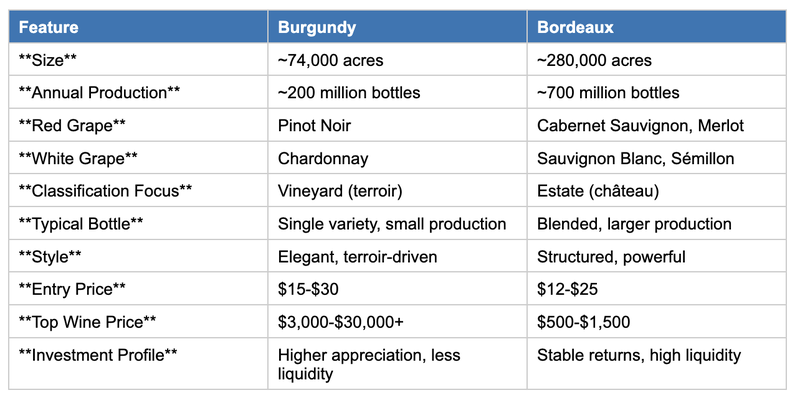
Geographic and Climate Differences
Burgundy
Location: Eastern France, between Dijon and Lyon
Climate: Continental — cold winters, warm summers, significant vintage variation
Key Subregions:
- Chablis (northernmost, mineral Chardonnay)
- Côte de Nuits (Grand Cru Pinot Noir)
- Côte de Beaune (Premier/Grand Cru whites and reds)
- Côte Chalonnaise (value wines)
- Mâconnais (accessible Chardonnay)
Terroir Philosophy: Burgundy obsesses over terroir — the unique combination of soil, slope, exposure, and microclimate that each vineyard possesses. The same producer may make dramatically different wines from adjacent plots.
Bordeaux
Location: Southwestern France, around the Gironde estuary
Climate: Maritime — moderate temperatures, Atlantic influence, more consistent vintages
Key Subregions:
- Médoc/Haut-Médoc (Cabernet-dominant Left Bank)
- Pauillac, Margaux, Saint-Julien, Saint-Estèphe (classified estates)
- Pomerol, Saint-Émilion (Merlot-dominant Right Bank)
- Graves/Pessac-Léognan (reds and dry whites)
- Sauternes/Barsac (sweet wines)
Terroir Philosophy: Bordeaux focuses on estates (châteaux) rather than individual vineyard plots. A château's reputation drives pricing more than specific terroir differences within the property.
Grape Varieties and Styles
Burgundy: Purity and Precision
Red: Pinot Noir
- Single variety (no blending)
- Light to medium body
- Transparent color
- Red fruit (cherry, raspberry, strawberry)
- Earthy, mushroom notes with age
- Silky tannins
- High acidity
White: Chardonnay
- Single variety
- Ranges from lean (Chablis) to rich (Meursault)
- Apple, citrus, mineral in cooler sites
- Butter, toast, tropical in warmer sites/oak
- Exceptional aging potential
Burgundy Character: Elegance over power. Burgundy wines whisper rather than shout, revealing layers of complexity to attentive tasters. The goal is expressing terroir, not winemaker intervention.
Bordeaux: Structure and Complexity
Red: Bordeaux Blends
- Left Bank: Cabernet Sauvignon-dominant (60-85%), with Merlot, Cabernet Franc
- Right Bank: Merlot-dominant (60-90%), with Cabernet Franc
- Full body, deep color
- Black fruit (cassis, blackberry, plum)
- Cedar, tobacco, graphite notes
- Firm tannins (especially young)
- Built for aging
White: Bordeaux Blends
- Dry: Sauvignon Blanc/Sémillon blends
- Sweet: Sémillon-dominant (Sauternes)
- Ranges from crisp to rich
Bordeaux Character: Structure and longevity. Bordeaux wines are built to last — firm tannins in youth that soften over decades, revealing complexity.
Classification Systems
Burgundy: Vineyard-Based Pyramid
Burgundy classifies vineyard plots, not estates:
- Grand Cru (~1-2% of production)
- 33 red, 8 white vineyards
- Highest quality potential
- No village name on label (vineyard speaks for itself)
- Examples: Romanée-Conti, Chambertin, Montrachet
- Premier Cru (~10-12%)
- ~635 classified vineyards
- Excellent quality
- Village name + vineyard name on label
- Village (~35-37%)
- Named village wines
- Good quality, accessible
- Regional (~50-52%)
- Generic "Bourgogne" appellation
- Entry-level
Key Insight: In Burgundy, the same vineyard may have multiple owners making different wines. Knowing both vineyard AND producer is essential.
Bordeaux: Estate-Based Classification
Bordeaux classifies estates (châteaux), not vineyards:
1855 Classification (Médoc):
- First Growth (5 estates): Lafite, Latour, Margaux, Mouton, Haut-Brion
- Second through Fifth Growths: 56 additional estates
- Unchanged since 1855 (except Mouton's 1973 promotion)
Saint-Émilion Classification:
- Premier Grand Cru Classé A (4 estates)
- Premier Grand Cru Classé B (14 estates)
- Grand Cru Classé (71 estates)
- Revised every ~10 years
Key Insight: In Bordeaux, estate reputation determines everything. A château can expand vineyards; new plantings inherit the classification.
Price Comparison (2026)
Entry Level
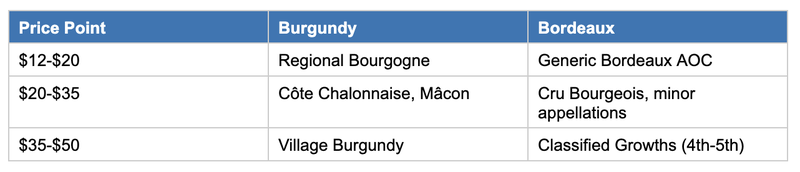
Value Verdict: Bordeaux offers better value at entry level — more wine quality per dollar under $35.
Mid-Range
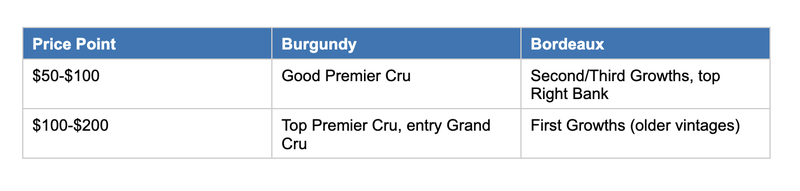
Value Verdict: Both regions offer exceptional quality at this level. Personal preference determines best choice.
Investment Grade
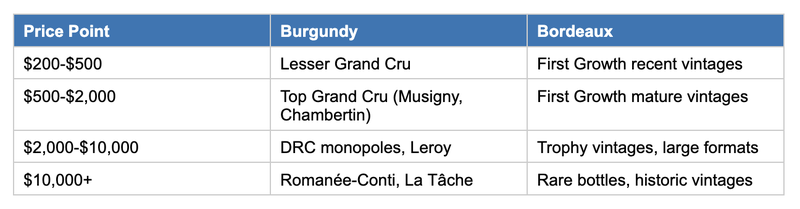
Investment Verdict: Burgundy's top wines command higher prices and have shown stronger appreciation. Bordeaux offers better liquidity and more predictable returns.
Investment Analysis
Burgundy Investment Profile
Strengths:
- Highest appreciation potential: Liv-Ex Burgundy 150 up +227% over 10 years
- Extreme scarcity: Tiny production from top sites
- Growing Asian demand: Chinese and Japanese collectors driving prices
- Quality consistency: Top producers rarely disappoint
Weaknesses:
- Lower liquidity: Smaller production = fewer bottles trading
- Producer dependency: Quality varies wildly
- Authentication concerns: Higher counterfeiting risk
- Entry barriers: Allocation required for best wines
Top Investment Targets:
- Domaine de la Romanée-Conti (all wines)
- Domaine Leroy
- Domaine Armand Rousseau
- Domaine Georges Roumier
- Domaine Dujac
Bordeaux Investment Profile
Strengths:
- High liquidity: Large production, active trading
- Global recognition: Universal brand awareness
- Established market: Centuries of auction history
- Consistent supply: Reliable annual releases
Weaknesses:
- Lower appreciation: More modest returns than Burgundy
- Market maturity: Less upside potential
- Vintage dependency: Off-years underperform
- Competition: Many estates, diluted demand
Top Investment Targets:
- Château Lafite Rothschild
- Château Latour
- Château Margaux
- Château Pétrus
- Château Le Pin
Historical Performance
10-Year Returns (approximate):
- Liv-Ex Burgundy 150: +227%
- Liv-Ex Bordeaux 500: +55%
- S&P 500: +170%
Burgundy has dramatically outperformed Bordeaux, though with higher volatility and lower liquidity.
Food Pairing Differences
Burgundy Pairings
Red Burgundy (Pinot Noir):
- Duck (classic)
- Coq au Vin
- Roasted chicken
- Salmon and rich fish
- Mushroom dishes
- Soft cheeses (Époisses, Brie)
- Lighter preparations of beef
White Burgundy (Chardonnay):
- Lobster
- Scallops
- Roasted chicken
- Creamy pasta
- Rich fish (turbot, Dover sole)
- Comté cheese
Principle: Burgundy's elegance calls for refined dishes that won't overpower the wine's subtlety.
Bordeaux Pairings
Red Bordeaux:
- Lamb (the classic)
- Grilled ribeye
- Roast beef
- Hard cheeses (Manchego, aged Cheddar)
- Rich stews
- Game meats
White Bordeaux:
- Oysters (dry whites)
- Foie gras (Sauternes)
- Roquefort (Sauternes)
- Seafood
- Goat cheese
Principle: Bordeaux's structure handles rich, fatty, substantial dishes that would overwhelm Burgundy.
Which Should You Choose?
Choose Burgundy If You:
- Appreciate elegance over power
- Value terroir expression
- Enjoy lighter-bodied reds
- Prefer single-variety wines
- Seek highest appreciation potential (investment)
- Don't mind premium prices
- Value subtlety and complexity
Choose Bordeaux If You:
- Prefer structured, powerful wines
- Appreciate blending artistry
- Want cellar-worthy wines at lower entry prices
- Need investment liquidity
- Enjoy consistent style year to year
- Pair wine with rich foods
- Value reliability and recognition
The Best Answer: Both
Most serious wine lovers come to appreciate both regions for different occasions:
- Burgundy for contemplative drinking, lighter fare, special bottles
- Bordeaux for hearty meals, cellaring, reliable quality
The Bottom Line
Burgundy and Bordeaux represent two distinct philosophies of winemaking. Burgundy seeks to express terroir through single varieties, creating wines of transparency and nuance. Bordeaux builds wines through blending, creating structured, powerful wines meant to evolve over decades.
Neither is "better" — they're simply different. Understanding both enriches your wine experience immeasurably.
For investors, Burgundy offers higher potential returns with higher risk and lower liquidity. Bordeaux provides stable, liquid investments with more modest appreciation.
For drinkers, the choice comes down to personal preference: do you favor elegance or power, subtlety or structure, Pinot Noir or Cabernet Sauvignon?
The greatest wine lovers embrace both, recognizing that France's twin pillars of wine culture each offer something irreplaceable.
Best Bottles to Buy: Burgundy (2026)
Entry Level ($25-$50)
Bourgogne Rouge:
- Louis Jadot Bourgogne Pinot Noir ($18-$24)
- Joseph Drouhin Bourgogne ($20-$28)
- Domaine Faiveley Bourgogne ($22-$30)
Bourgogne Blanc:
- Roulot Bourgogne Blanc ($35-$45)
- Louis Latour Bourgogne Chardonnay ($18-$24)
Mid-Range ($50-$150)
Village Wines:
- Gevrey-Chambertin (various producers) ($50-$100)
- Volnay (various producers) ($45-$90)
- Meursault (various producers) ($60-$120)
Top Producers:
- Domaine Dujac Village wines ($70-$120)
- Domaine de Montille ($60-$100)
- Domaine Roulot ($80-$150)
Investment Grade ($150-$5,000+)
Grand Cru Red:
- Chambertin ($300-$800)
- Musigny ($400-$1,500)
- Romanée-Saint-Vivant ($400-$1,200)
Grand Cru White:
- Montrachet ($500-$2,000)
- Chevalier-Montrachet ($300-$800)
- Corton-Charlemagne ($150-$500)
Trophy Wines:
- DRC Romanée-Conti ($15,000-$30,000)
- DRC La Tâche ($3,000-$6,000)
- Leroy Musigny ($8,000-$15,000)
Best Bottles to Buy: Bordeaux (2026)
Entry Level ($15-$40)
Generic Bordeaux/Bordeaux Supérieur:
- Château Bonnet ($12-$16)
- Mouton Cadet ($14-$18)
- Various Cru Bourgeois ($18-$35)
Mid-Range ($40-$100)
Classified Growths (4th-5th):
- Château Talbot ($45-$60)
- Château Lynch-Bages ($80-$100)
- Château Grand-Puy-Lacoste ($50-$70)
Right Bank Value:
- Château Canon-La-Gaffelière ($50-$75)
- Clos Fourtet ($70-$90)
Investment Grade ($100-$1,000+)
First Growths:
- Château Lafite Rothschild ($400-$800)
- Château Latour ($350-$700)
- Château Margaux ($400-$800)
- Château Mouton Rothschild ($350-$700)
- Château Haut-Brion ($350-$600)
Super Seconds:
- Château Léoville-Las Cases ($150-$250)
- Château Pichon-Baron ($120-$180)
- Château Cos d'Estournel ($130-$200)
Right Bank Icons:
- Château Pétrus ($2,500-$5,000)
- Le Pin ($2,000-$4,000)
- Château Cheval Blanc ($400-$800)
Vintage Guide
Burgundy Outstanding Vintages
Red:
- 2019 ★★★★★ — Exceptional, age-worthy
- 2018 ★★★★☆ — Rich, approachable
- 2017 ★★★★☆ — Fresh, elegant
- 2015 ★★★★★ — Classic, balanced
- 2010 ★★★★★ — Structured, long-lived
White:
- 2020 ★★★★★ — Concentrated, balanced
- 2019 ★★★★★ — Rich, complex
- 2017 ★★★★★ — Fresh, pure
- 2014 ★★★★★ — Classic, mineral
- 2010 ★★★★★ — Age-worthy
Bordeaux Outstanding Vintages
Left Bank:
- 2019 ★★★★★ — Exceptional across board
- 2018 ★★★★★ — Rich, powerful
- 2016 ★★★★★ — Classic, structured
- 2015 ★★★★★ — Elegant, balanced
- 2010 ★★★★★ — Legendary
Right Bank:
- 2019 ★★★★★ — Outstanding Merlot
- 2018 ★★★★★ — Ripe, concentrated
- 2015 ★★★★★ — Exceptional Merlot
- 2010 ★★★★★ — Structured, age-worthy
- 2009 ★★★★★ — Legendary
Frequently Asked Questions
Which is more expensive, Burgundy or Bordeaux?
At the top: Burgundy is far more expensive. DRC Romanée-Conti costs $15,000-$30,000 vs. $400-$800 for Bordeaux First Growths.
At entry level: Bordeaux offers better value. Basic Bordeaux costs $12-$20 vs. $18-$30 for basic Bourgogne.
Which is better for investment?
Burgundy: Higher appreciation potential (+227% over 10 years for top wines) but lower liquidity and higher risk.
Bordeaux: More stable returns (+55% over 10 years), excellent liquidity, established auction market.
Which is better for beginners?
Bordeaux is often recommended for beginners:
- More consistent style year to year
- Easier to understand (estate-based)
- Lower entry prices
- More forgiving of service temperature
Burgundy can be confusing:
- Many producers per vineyard
- Vintage variation is extreme
- Higher prices for equivalent quality
- Requires more knowledge to navigate
Why is Burgundy so expensive?
Several factors:
- Tiny production: Grand Cru vineyards are small
- No expansion: Vineyard boundaries are fixed
- Growing demand: Asian collectors drive prices
- Quality: Top wines are genuinely exceptional
- Reputation: Centuries of prestige
What's the difference between Left Bank and Right Bank Bordeaux?
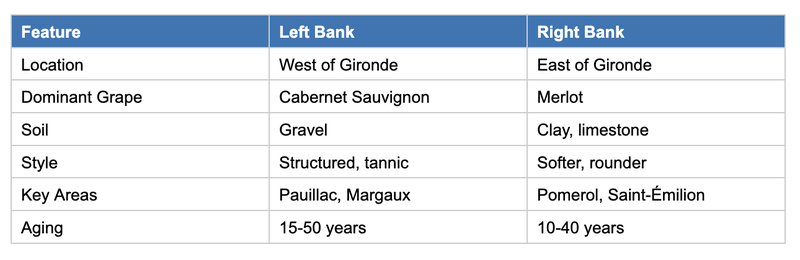
Can you age Burgundy as long as Bordeaux?
Top Burgundy can age 30-50+ years, comparable to Bordeaux.
Key difference: Burgundy evolves differently:
- Develops earthy, truffle notes
- Becomes more delicate with age
- Requires careful storage
- Peak windows are often shorter
Which region is more affected by climate change?
Both face challenges:
Burgundy: Earlier harvests, higher alcohol, concerns about Pinot Noir viability long-term.
Bordeaux: Adapting varieties, exploring higher altitudes, Merlot ripening earlier.
Bordeaux may be more adaptable due to blending flexibility.
How do you pronounce the regions correctly?
- Burgundy: "BUR-gun-dee"
- Bordeaux: "bore-DOH"
- Pauillac: "poy-YAK"
- Margaux: "mar-GO"
- Pomerol: "pom-eh-ROLL"
- Gevrey-Chambertin: "zhev-RAY sham-bear-TAN"
- Vosne-Romanée: "VONE ro-mah-NAY"
What food pairs best with each region?
Burgundy Red (Pinot Noir):
- Roasted duck
- Coq au Vin
- Mushroom dishes
- Soft cheeses
- Salmon (unusually for red)
Burgundy White (Chardonnay):
- Lobster
- Scallops
- Roasted chicken
- Comté cheese
Bordeaux Red:
- Lamb (the classic)
- Ribeye steak
- Hard cheeses
- Rich stews
Which should I collect first?
Start with Bordeaux:
- Lower entry prices
- Better availability
- Established resale market
- Easier to understand
Graduate to Burgundy:
- After building Bordeaux foundation
- When budget allows
- With good merchant relationships
- Understanding quality hierarchy
Why are there so many small producers in Burgundy?
Napoleonic inheritance laws: When landowners died, vineyards were divided equally among heirs. Over generations, this fragmented ownership dramatically.
Result: A single vineyard like Clos de Vougeot has 80+ different owners making wine from tiny plots.
What's a "négociant"?
A négociant buys grapes or wine from growers and produces wine under their own label:
Burgundy négociants: Louis Jadot, Joseph Drouhin, Bouchard Père et Fils
Bordeaux négociants: Less common, but houses like CVBG handle distribution
Négociants can offer good value and consistent quality across multiple appellations.
Turn your wine interest into a portfolio with Vinovest. Get access to authenticated bottles, professional storage, insurance, and ongoing portfolio management in one place.