
Asti Spumante: The Complete Guide to Italy's Beloved Sweet Sparkling Wine (2026)
Asti Spumante is Italy's most popular sweet sparkling wine — a celebration in a glass that has delighted wine lovers worldwide for over 150 years. Made exclusively from Moscato Bianco grapes in Piedmont's rolling hills, this aromatic, refreshing sparkler offers an accessible entry point to Italian wine culture while delivering genuine quality that belies its modest price point.
Whether you're planning a celebration, searching for the perfect dessert pairing, or simply curious about this iconic Italian bubbly, this comprehensive guide covers everything you need to know about Asti Spumante in 2026: production methods, best brands, pricing, food pairings, and how it compares to Moscato d'Asti, Prosecco, and Champagne.
Further reading
- Explore rich Merlot Wines and Refreshing Pinot Grigio!
- Discover The Best Wine Brands and the most sought after French Wines.
What is Asti Spumante?
Asti Spumante (often simply called "Asti" since 1993) is a fully sparkling (spumante) sweet white wine produced in the Asti DOCG zone of Piedmont, northwestern Italy. The wine must be made entirely from Moscato Bianco grapes (also known as Muscat Blanc à Petits Grains), one of the oldest and most aromatic grape varieties in existence.
Key Characteristics:
- Sweetness: Sweet, with approximately 80-100 grams of residual sugar per liter
- Alcohol: Low, typically 7-9.5% ABV (compared to 12-14% for most wines)
- Bubbles: Fully sparkling with lively, persistent effervescence
- Color: Pale straw yellow with golden highlights
- Aromas: Intensely aromatic with notes of white peach, apricot, honey, orange blossom, and sage
- Classification: DOCG (Denominazione di Origine Controllata e Garantita) — Italy's highest quality designation
The name "Asti Spumante" translates literally to "sparkling wine from Asti," referring to the town of Asti in Piedmont where production centers. Since the 1993 DOCG promotion, most producers label their wines simply as "Asti" to distance themselves from the "cheap sweet bubbly" reputation that plagued "Asti Spumante" in the late 20th century.
A Brief History of Asti Spumante
Origins and Innovation
The Moscato Bianco grape has grown in Piedmont for nearly a thousand years, but sparkling Asti as we know it was invented in 1870 by Carlo Gancia. After studying Champagne production methods in France, Gancia returned to Italy and created the first sparkling Moscato — giving birth to what would become Italy's most widely produced quality sparkling wine.
American Popularity
Asti Spumante's international breakthrough came after World War II. American soldiers returning from Italy brought their taste for the sweet, affordable sparkler home with them. Demand surged, and Italian producers rapidly scaled production to meet export needs.
Unfortunately, this mass production era damaged Asti's reputation. Wine critic Karen MacNeil described the exports of this period as "a noxiously sweet poor man's Champagne." The pursuit of volume over quality left Asti Spumante associated with cheap, cloying sweetness rather than genuine craftsmanship.
The 1993 Renaissance
When Asti achieved DOCG status in 1993 — Italy's highest wine classification — quality-focused producers seized the opportunity for reinvention. The "Spumante" suffix was officially made optional, allowing producers to market their wines simply as "Asti" and signal a break from the low-quality past.
Today's best Asti producers demonstrate that this wine, made properly, offers remarkable aromatic complexity and refreshing balance — a far cry from the sticky-sweet industrial products of decades past.
How Asti Spumante Is Made
The Charmat (Tank) Method
Unlike Champagne, which undergoes secondary fermentation in individual bottles, Asti is made using the Charmat method (also called metodo Italiano or the tank method). This approach preserves the grape's fresh, primary fruit aromas while allowing efficient production.
The Production Process:
- Harvest: Moscato Bianco grapes are hand-harvested at optimal ripeness from vineyards in the Asti DOCG zone.
- Crushing and Pressing: Grapes are gently crushed to release their aromatic juice while minimizing skin contact that could add bitterness.
- Chilling: The grape must (fresh juice) is chilled to near-freezing temperatures to prevent fermentation from beginning prematurely.
- Tank Fermentation: The must is transferred to pressurized stainless steel tanks where temperature is raised and yeast is added. Fermentation begins in a sealed environment.
- Capturing the Bubbles: As yeast converts sugar to alcohol, carbon dioxide is produced. In sealed tanks, this CO2 dissolves into the wine, creating Asti's characteristic sparkle.
- Stopping Fermentation: When alcohol reaches 7-9.5%, fermentation is halted by rapidly chilling the wine. This preserves residual sugar (sweetness) and the grape's aromatic compounds.
- Filtration: The wine is filtered to remove yeast and stabilize the product.
- Bottling: Wine is bottled under pressure to maintain effervescence.
DOCG Requirements
All Asti DOCG wines must meet strict regulations:
- Grape: 100% Moscato Bianco
- Yield: Maximum 10 tonnes per hectare
- Alcohol: Minimum 7%, maximum 9.5%
- Pressure: Minimum 3.5 atmospheres (fully sparkling)
- Origin: Grapes must come from designated communes in Piedmont provinces of Asti, Cuneo, and Alessandria
These requirements ensure baseline quality, though individual producer practices determine actual excellence.
Asti Spumante vs. Moscato d'Asti: Understanding the Difference
These two wines share the same grape, region, and DOCG classification, but they're distinctly different products. Understanding these differences helps you choose the right wine for your needs.
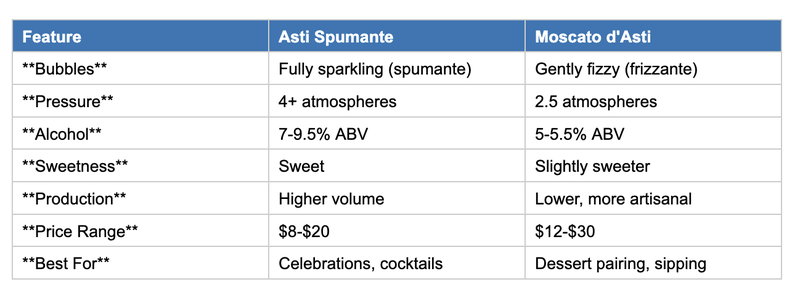
Asti Spumante is the party wine — lively bubbles, slightly higher alcohol, and effervescent character make it perfect for toasts and celebrations.
Moscato d'Asti is the contemplative choice — gentle fizz, lower alcohol, and often more nuanced aromatics make it ideal for dessert pairing or relaxed afternoon enjoyment.
Both are excellent in their own context. Asti Spumante's vivacious character suits festive occasions; Moscato d'Asti's delicacy rewards thoughtful pairing and leisurely consumption.
Asti Spumante vs. Prosecco vs. Champagne
How does Asti compare to other popular sparkling wines?
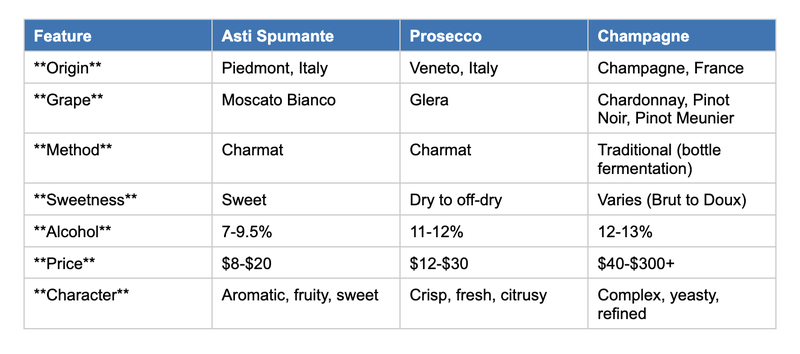
Choose Asti when you want sweet, aromatic sparkle without high alcohol — perfect for brunch, dessert, or guests who prefer sweeter wines.
Choose Prosecco when you want crisp, refreshing bubbles without sweetness — ideal for aperitifs, Bellinis, and food pairing.
Choose Champagne when you want complexity, prestige, and age-worthiness — the benchmark for special occasions and wine appreciation.
Best Asti Spumante Brands (2026)
Top Producers
Martini & Rossi Asti
- The world's most recognized Asti brand
- Price: $10-$14
- Style: Classic, approachable, consistent
- Tasting Notes: Peach, honey, white flowers, light sweetness
- Best For: Large gatherings, cocktails, everyday enjoyment
Gancia Asti
- Founded 1850 by Carlo Gancia, the inventor of sparkling Moscato
- Price: $12-$16
- Style: Historical producer, authentic Piedmont character
- Tasting Notes: Exotic fruit, sage, honey, vibrant bubbles
- Best For: Those seeking connection to Asti's origins
Fontanafredda Asti
- Historic estate with royal connections (King Vittorio Emanuele II)
- Price: $14-$18
- Style: Elegant, refined, carefully crafted
- Tasting Notes: Apricot, orange blossom, mineral freshness
- Best For: More sophisticated occasions, discerning palates
Tosti Asti
- Major producer with wide availability
- Price: $9-$13
- Style: Sweet, fruity, crowd-pleasing
- Tasting Notes: Lemon, candied fruit, honey, soft mousse
- Best For: Casual celebrations, value seekers
Riccadonna Asti
- Established 1921, century of expertise
- Price: $11-$15
- Style: Classic Piedmont expression
- Tasting Notes: Stone fruit, floral notes, balanced sweetness
- Best For: Traditional Asti character
Contratto Asti
- Small-production, quality-focused
- Price: $18-$25
- Style: Artisanal, can age 4+ years
- Tasting Notes: Complex, layered, aged up to 2 months in bottle
- Best For: Collectors, those seeking premium Asti expression
Cinzano Asti
- Historic vermouth producer's sparkler
- Price: $10-$14
- Style: Approachable, well-balanced
- Tasting Notes: Fresh peach, almond, floral lift
- Best For: Accessible quality at reasonable price
Premium and Boutique Options
For those seeking elevated Asti experiences:
Paolo Saracco Moscato d'Autunno
- Small-production excellence
- Price: $25-$35
- Style: Artisanal precision, exceptional aromatics
Ceretto Moscato d'Asti "I Vignaioli di Santo Stefano"
- Top Barolo producer's Moscato
- Price: $20-$28
- Style: Elegant, refined, benchmark quality
Braida Moscato d'Asti "Vigna Senza Nome"
- Legendary producer Giacomo Bologna's legacy
- Price: $22-$30
- Style: Complex, age-worthy, exceptional terroir expression
Asti Spumante Prices (2026)
Price Tiers
Value Tier ($8-$12)
- Martini & Rossi, Tosti, store brands
- Good for parties, large gatherings, cocktails
- Reliable quality, wide availability
Standard Tier ($12-$18)
- Gancia, Fontanafredda, Riccadonna, Cinzano
- Better complexity and craftsmanship
- Ideal for gifting, nicer occasions
Premium Tier ($18-$30)
- Contratto, small producers
- Artisanal production, superior quality
- Worth seeking for special occasions
Luxury Tier ($30+)
- Rare cuvées, vintage releases
- Limited availability
- Collector interest
Value Perspective
Asti Spumante offers exceptional value in the sparkling wine world. For $10-$15, you get:
- DOCG quality assurance
- 100% Moscato Bianco aromatics
- Festive bubbles for any celebration
- Lower alcohol for extended enjoyment
- Crowd-pleasing sweetness
Compare this to entry-level Champagne at $40+ or even Prosecco at $15-$20, and Asti's value proposition becomes clear.
Food Pairing Guide
Perfect Pairings
Asti Spumante's sweetness and aromatics call for specific pairing strategies:
Desserts (the classic match):
- Fresh fruit tarts (peach, apricot, berry)
- Panna cotta
- Biscotti and cookies
- Light cakes (angel food, sponge)
- Fruit salads
- Gelato and sorbet
- Panettone (traditional Italian pairing)
Cheese:
- Gorgonzola (sweet wine cuts richness)
- Fresh ricotta with honey
- Mascarpone preparations
- Mild blue cheeses
Brunch:
- Fresh fruit platters
- French toast with maple syrup
- Pancakes and waffles
- Fruit crepes
Appetizers:
- Prosciutto with melon
- Bruschetta with fresh tomatoes
- Antipasto plates (sweet elements)
- Spiced nuts
Asian Cuisine (surprising but excellent):
- Mild Thai curries
- Dim sum
- Sweet and sour dishes
- Spring rolls
Pairing Principles
Match sweetness: Asti's sugar needs food of equal or lesser sweetness. Pairing with very sweet desserts can make the wine seem flat.
Contrast richness: Sweet bubbles cut through fatty, rich foods beautifully.
Complement aromatics: Dishes featuring peach, apricot, honey, or orange pair harmoniously.
Avoid: Very savory or umami-heavy dishes, heavy red meats, strongly spiced foods.
How to Serve Asti Spumante
Temperature
Ideal serving temperature: 40-45°F (4-7°C)
Asti should be well-chilled but not ice-cold:
- Too warm: Sweetness becomes cloying, bubbles dissipate
- Too cold: Aromatics are muted, flavors are suppressed
- Just right: Refreshing sweetness, vibrant aromatics, lively bubbles
Chilling methods:
- Refrigerator: 3-4 hours
- Ice bucket with water and ice: 20-30 minutes
- Freezer: 15-20 minutes (don't forget it!)
Glassware
Flute or tulip glass is ideal:
- Concentrates aromatics at the rim
- Displays bubble streams attractively
- Maintains temperature longer than wide glasses
Avoid:
- Coupe glasses (bubbles dissipate quickly)
- Very wide glasses (aromas escape)
Opening the Bottle
- Remove foil and wire cage while keeping thumb on cork
- Hold bottle at 45-degree angle, pointing away from people
- Grip cork firmly and twist the BOTTLE, not the cork
- Control the release — a gentle "sigh" is more elegant than a loud pop
- Pour slowly to minimize foam overflow
Storage
Asti is made for drinking young:
- Before opening: Store horizontally in cool, dark place (55°F ideal)
- Drink within: 1-2 years of purchase for best freshness
- After opening: Reseal with sparkling wine stopper; consume within 24-48 hours
Asti Spumante Cocktails
Classic Recipes
Asti Mimosa
- 3 oz Asti Spumante
- 2 oz fresh orange juice
- Pour orange juice, top with chilled Asti
- Sweeter, more aromatic than traditional Champagne mimosa
Asti Bellini
- 3 oz Asti Spumante
- 1 oz white peach purée
- Combine in chilled flute
- Perfect pairing — peach notes in wine complement peach purée
Asti Spritz
- 3 oz Asti Spumante
- 1 oz Aperol
- 1 oz sparkling water
- Serve over ice with orange slice
- Sweet-bitter balance
Rossini
- 3 oz Asti Spumante
- 1 oz strawberry purée
- Combine in flute
- Romantic and celebratory
Tips for Cocktails
- Use well-chilled Asti for best results
- Don't over-mix — preserve the bubbles
- Asti's sweetness means less (or no) added sugar needed
- Low alcohol makes Asti cocktails sessionable
Health Considerations
Calories and Sugar
Per 5 oz (150ml) serving:
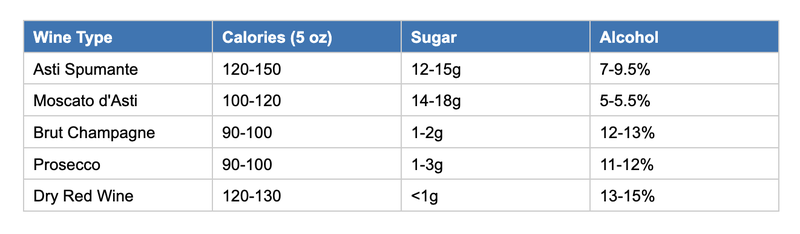
- Calories: 120-150 (lower than many wines due to low alcohol)
- Sugar: 12-15 grams (sweet wine — be aware if monitoring intake)
- Carbohydrates: 12-15 grams
- Alcohol: Less than standard wine
Benefits of Lower Alcohol
At 7-9.5% ABV, Asti contains roughly half the alcohol of standard wine:
- Slower intoxication
- Fewer calories from alcohol
- Easier morning after
- Suitable for afternoon events
- Extended enjoyment without overindulgence
Considerations
- Sweetness: High residual sugar means higher carbs/calories per glass
- Sulfites: Present, as in most wines
- Best approach: Enjoy in moderation as part of balanced lifestyle
Nutritional Comparison
Frequently Asked Questions
What does Asti Spumante taste like?
Asti Spumante tastes sweet and aromatic, with dominant flavors of:
- Fresh white peach (most prominent)
- Ripe apricot
- Orange blossom
- Honey
- Subtle sage and herbs
The wine is refreshing despite its sweetness, with lively bubbles that lift the palate.
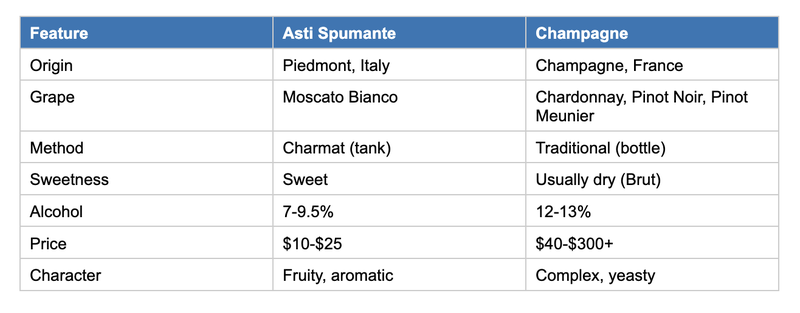
Is Asti Spumante the same as Champagne?
No, they're quite different:
Is Asti Spumante good for mimosas?
Yes! Asti makes excellent mimosas with a twist:
- Sweeter than traditional Champagne mimosas
- More aromatic and fruity
- Lower alcohol for brunch enjoyment
- Pairs beautifully with fresh orange juice
How do you pronounce Asti Spumante?
"AH-stee spoo-MAHN-tay" — four syllables for Asti, three for Spumante.
What's the difference between Asti and Moscato d'Asti?
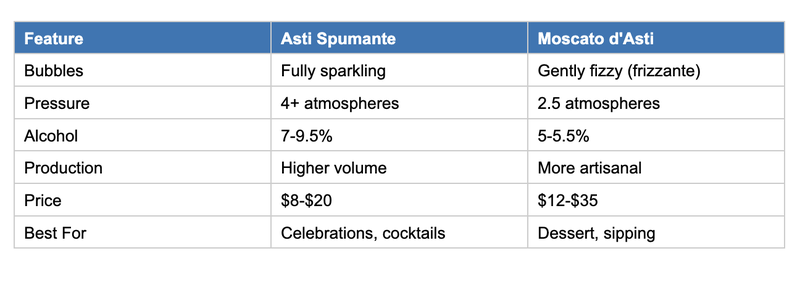
Should Asti Spumante be chilled?
Yes, serve well-chilled at 40-45°F (4-7°C):
- Refrigerate 3-4 hours before serving
- Ice bucket: 20-30 minutes
- Too warm = cloying sweetness
- Just right = refreshing and balanced
How long does Asti Spumante last after opening?
- With sparkling wine stopper: 24-48 hours refrigerated
- Without stopper: Drink same day
- Bubbles: Diminish quickly after opening
- Tip: Buy smaller bottles (375ml) for solo drinking
Can you age Asti Spumante?
No. Asti is made for immediate enjoyment:
- Drink within 1-2 years of purchase
- Does not improve with age
- Loses freshness and aromatics over time
- Always check for recent vintage/production date
Is Asti Spumante vegan?
Most Asti Spumante is vegan-friendly, as the Charmat method typically doesn't require animal-based fining agents. However, check with specific producers if concerned.
What food pairs best with Asti Spumante?
Perfect pairings:
- Fresh fruit tarts (peach, apricot)
- Panettone (classic Italian Christmas)
- Biscotti and cookies
- Light cakes
- Fresh berries with cream
Good pairings:
- Prosciutto with melon
- Mild cheeses
- Fruit salads
- Brunch dishes
Avoid:
- Heavy savory dishes
- Strong cheeses
- Red meats
- Very sweet desserts (sweeter than the wine)
Why did they drop "Spumante" from the name?
When Asti achieved DOCG status in 1993, producers wanted to distance themselves from the low-quality reputation that "Asti Spumante" had acquired during the mass-production era. The shortened "Asti" name signals quality-focused production, though "Asti Spumante" remains technically correct and still appears on some labels.
Is Asti Spumante sweet or dry?
Asti Spumante is definitely sweet, containing approximately 80-100 grams of residual sugar per liter. This places it firmly in the "sweet" category. If you prefer dry sparkling wine, choose Prosecco Brut or Champagne Brut instead.
How much alcohol is in Asti Spumante?
Asti Spumante contains 7-9.5% alcohol by volume (ABV), which is:
- Lower than most wines (12-14%)
- About half the alcohol of Champagne
- Similar to many beers
- Higher than Moscato d'Asti (5-5.5%)
What's the best Asti Spumante brand?
For value: Martini & Rossi ($10-$14) — consistent, widely available
For quality: Fontanafredda ($14-$18) — refined, elegant
For history: Gancia ($12-$16) — original sparkling Moscato producer
For special occasions: Contratto ($18-$25) — artisanal, age-worthy
Can diabetics drink Asti Spumante?
Asti's high sugar content (12-15g per glass) requires careful consideration for diabetics:
- Consult healthcare providers
- Consider smaller portions
- Account for carbohydrates
- Dry sparkling wines may be better alternatives
Is Asti Spumante gluten-free?
Yes. Wine, including Asti Spumante, is naturally gluten-free as it's made from grapes, not grains. However, those with severe celiac disease should verify that no gluten-containing products were used in production.
The History of Asti: From Monks to Modern Day
Ancient Origins
The Moscato Bianco grape has grown in Piedmont for nearly a millennium, with records of cultivation dating to the medieval period. Monks and local farmers produced still, sweet Moscato wines for centuries before sparkling production began.
Carlo Gancia's Innovation (1870)
The modern history of Asti Spumante begins with Carlo Gancia, who studied Champagne production in France and returned to Italy determined to create sparkling wine from Moscato grapes. His 1870 innovation — adapting tank fermentation to preserve Moscato's aromatic qualities — gave birth to the Asti Spumante category.
Post-War Boom and Bust
After World War II, returning American soldiers brought their taste for Asti home, sparking export demand. Italian producers scaled up rapidly, often prioritizing volume over quality. By the 1970s-80s, "Asti Spumante" had become synonymous with cheap, overly sweet wine — unfairly tarnishing the entire category.
The 1993 Renaissance
DOCG classification in 1993 marked a turning point. Quality-focused producers:
- Embraced stricter regulations
- Dropped "Spumante" from labels
- Invested in better viticulture
- Targeted quality over quantity
Today's best Asti producers demonstrate that this wine, made properly, offers genuine quality and complexity.
World Moscato Day
Celebrated annually on May 9th, World Moscato Day honors the grape variety that makes Asti possible. It's an opportunity to explore the full range of Moscato wines, from gentle Moscato d'Asti to festive Asti Spumante.
Buying Guide
Where to Buy
Retail Stores:
- Total Wine & More (wide selection)
- BevMo (West Coast)
- Local wine shops
- Grocery stores (major brands)
Online:
- Wine.com
- Drizly
- Total Wine online
- Vivino marketplace
What to Look For
- DOCG designation: Ensures authentic Asti production
- Recent vintage or NV: Asti doesn't age well; freshness matters
- Intact packaging: Check for leakage or damage
- Producer reputation: Stick with established brands for reliability
What to Avoid
- Very old bottles (over 2-3 years)
- Damaged corks or wet labels (storage problems)
- Non-DOCG "Moscato Spumante" (lower quality requirements)
- Bottles stored upright in warm conditions
The Bottom Line
Asti Spumante offers something genuinely valuable in the wine world: an affordable, accessible, delicious sparkling wine that brings joy to any celebration. While wine snobs may dismiss it, those who appreciate Asti understand its purpose — it's not trying to be Champagne, and that's perfectly fine.
At its best, Asti Spumante delivers:
- Vibrant, aromatic flavors of peach, apricot, and honey
- Refreshing sweetness balanced by lively bubbles
- Low alcohol for extended enjoyment
- DOCG quality assurance
- Exceptional value ($10-$20 for genuine quality)
Whether you're toasting a milestone, pairing with dessert, mixing cocktails for brunch, or simply enjoying a casual celebration, Asti Spumante delivers festive pleasure without pretension. For millions of wine lovers worldwide, that's exactly what a great sparkler should do.
Build an investment grade Italian wine portfolio with Vinovest. We source, authenticate, store, and insure wines for long term ownership. Start with a quick quiz to see what fits your goals.