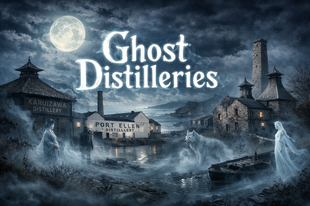
Ghost Distillery Whisky Investment: A 2026 Guide to Karuizawa, Port Ellen, Brora and Rosebank
In March 2026, two casks of Japanese whisky sold at Christie’s London for £4.25 million — the highest-value lots ever sold at a Christie’s Wine and Spirit auction. Both came from Karuizawa, a distillery that has been closed since 2000 and demolished since 2016. That single sale captures what makes “ghost” distilleries the most extraordinary corner of whisky investing: their supply is finite, their stocks shrink with every bottle opened, and the world will never make another drop. For collectors and investors, they are the closest thing whisky has to a unicorn asset class.
Ghost distilleries are whisky distilleries that have closed permanently — their remaining bottles and casks are finite, irreplaceable, and increasingly valuable. The four most important investment names are Karuizawa (Japan, closed 2000), Port Ellen (Islay, closed 1983), Brora (Highlands, closed 1983), and Rosebank (Lowland, closed 1993). Brora, Rosebank and Port Ellen have since been revived as new operations, but their original “silent era” stocks remain entirely distinct — and continue to command record prices, with a 2025 Brora 40-year-old hitting £54,450 and the 2026 Karuizawa cask sale setting a Christie’s record at £4.25 million.
Further reading
Whiskey Investment Guide 2026: How to Build Wealth with Rare Spirits
What Is a Ghost Distillery?
A ghost distillery (sometimes “silent distillery” or “lost distillery”) is one that has ceased production permanently — in most cases, decades ago, with no realistic prospect of resuming operations at the time of closure. The remaining spirit continues to age in warehouses, shrinking each year through the “angel’s share” of evaporation, but no new make will ever flow from those stills again.
Most of Scotland’s ghost distilleries closed during the 1970s and 1980s, a brutal period when oil-driven inflation, global recession, and a generational shift away from brown spirits forced an industry-wide retrenchment. Many of the wines and whiskies these distilleries had produced were destined for blends; nobody was drinking them as single malts, and the closures barely registered at the time. It would be decades before the rarity of what had been lost was understood.
Why Ghost Distillery Whisky Is the Holy Grail
The investment case for closed-distillery whisky rests on four interlocking factors:
- Absolutely finite supply. No new bottlings of the original distillate will ever be made. Every bottle opened is gone forever — a constantly shrinking pool.
- Documented track records. The Karuizawa Whisky Index returned roughly 18.9% annualised between 2007 and 2022. The Rare Whisky 101 index showed Brora values up 34% in a single year at the height of the boom.
- Record-setting auctions. A bottle of Karuizawa that traded for £12,000 in 2013 sold for £100,100 just two years later. Recent peaks include a 52-year-old Karuizawa at $372,684 (Sotheby’s Hong Kong, 2024) and the March 2026 Christie’s cask sale at £4.25 million.
- Story and provenance. Each ghost distillery has a unique narrative — collapse, silence, rediscovery, sometimes resurrection. That story is part of what collectors are buying, and it travels well across markets and generations.
The Big Four Ghost Distilleries
Four names dominate ghost distillery investment. Three are Scottish and have now been revived; one is Japanese and is gone forever.
1. Karuizawa (Japan) — The Demolished Legend
Founded in 1955 in the foothills of Mount Asama in Japan’s Southern Alps, Karuizawa produced richly sherried, structured single malt for nearly half a century before closing in 2000. The distillery was demolished in 2016, making its remaining stock truly irreplaceable — there are no buildings to revive, no stills to fire again. When Number One Drinks rescued the last 364 casks around 2010, they almost certainly secured what will prove to be the last great archive of one of the most collectible whisky names in history.
The market has responded accordingly. A 1960 52-year-old expression nicknamed “The Wanderer” sold for over $141,000 in 2017; the same year, another single bottle — “The Archer” — sold for over $125,000. The March 2026 Christie’s sale of two 1999 casks for £4.25 million marked a new ceiling. A new “Karuizawa Distillers” project broke ground on a nearby Komoro Distillery in 2024, but the spirit produced there will be different, made on different equipment in a different location — the original Karuizawa supply remains absolutely finite. For the broader Japanese whisky picture, see our Japanese whisky 2026 guide.
2. Port Ellen (Islay) — The Reborn Icon
Closed in 1983 along with Brora as part of Diageo predecessor DCL’s catastrophic retrenchment, Port Ellen was for decades the most legendary ghost distillery on Islay. Its pre-closure spirit (1978–1983) was made with island peat and hand-malted barley, and although it originally supplied blends, it has been celebrated since the 1990s through Diageo’s Rare Malts and Special Releases programmes. A 1979 40-year-old Special Release, bottled at 52.4% ABV from ex-bourbon casks, is widely regarded as one of the great modern Islay releases.
Diageo announced reopening plans in 2017 and ultimately invested an estimated £185 million ($233 million) to rebuild the distillery by 2024, with new spirit production beginning that year. Post-reopening spirit will follow traditional methods but is, by definition, a different era of whisky — which leaves the pre-1983 “silent era” stocks as a separate, finite, and increasingly cherished category. A Port Ellen 33-year-old cask was estimated by Sotheby’s at £700,000+ at auction.
3. Brora (Highland) — The Quiet Highland Legend
Brora was Port Ellen’s twin in the 1983 wave of closures — a Highland distillery on Scotland’s far north-east coast, famous for its waxy, faintly peated, mineral-driven single malt. Its closure was little noticed at the time, but the wines released through Diageo’s Rare Malts series in the 1990s built a reputation that has only grown. A 40-year-old Brora set an auction record of £54,450 in 2019. Diageo invested around £35 million to reopen the distillery, with production resuming in 2021. As with Port Ellen, the pre-1983 vintages remain a distinct — and finite — collector category.
4. Rosebank (Lowland) — The Triple-Distilled Revival
Rosebank closed in 1993, ten years after Port Ellen and Brora, but for the same broad reasons: shifting markets and surplus capacity. Its triple-distilled, light, floral Lowland style had become unfashionable, even though it would later be celebrated as one of the finest expressions of the region. Ian Macleod Distillers acquired the site and reopened the distillery in 2023, and recent single-cask releases of 1993 stock — cask strength, taken from refill ex-bourbon hogsheads — have been priced at £2,500 per bottle on release, with allocations distributed by ballot.
Honourable mentions: Hanyu (Japan, closed 2000) — home of the legendary Card Series, complete sets of which have sold for over $500,000; St. Magdalene (Lowland, closed 1983) — buildings have been converted to apartments, but warehoused stock matures on; Convalmore, Banff, Glen Mhor, Pittyvaich, and Glenugie complete the secondary tier of Scottish silent names.
Ghost Distilleries at a Glance
| Distillery | Region | Closed |
Status in 2026 |
Notable Investment Note |
|---|---|---|---|---|
| Karuizawa | Japan | 2000 | Demolished; new project unrelated | £4.25M cask sale (Christie’s, 2026) |
| Port Ellen | Islay | 1983 | Reopened 2024 (£185M) | Pre-1983 stocks finite category |
| Brora | Highland | 1983 | Reopened 2021 (£35M) | 40yo at £54,450 (2019 record) |
| Rosebank | Lowland | 1993 | Reopened 2023 | 1993 single casks £2,500/bottle |
The Resurrection Paradox: Do Reopenings Undermine the Investment Case?
With three of the four flagship ghost distilleries now reborn, a natural question is whether the original investment case still holds. The answer, so far, has been clear: yes. New whisky from the reopened distilleries is made on new (or replica) stills, by new staff, in a different industry context — and crucially, it cannot legally carry the same age statement as the silent-era stock, because none of it is old enough yet. The pre-closure spirit is therefore a distinct asset class, defined by its origin date and its finite supply, regardless of what the new operation produces.
Rare Whisky 101 data from the years immediately after the Brora and Port Ellen reopening announcements showed values rising sharply rather than falling — a sign that the resurrection narrative is fuelling, not damaging, interest in the original stocks. Karuizawa, with no buildings or stills left to revive, sits in a category of its own.
How to Invest in Ghost Distillery Whisky
Ghost distillery investment concentrates at the high end of the market, where authentication and provenance matter most. There are three broad routes.
Option 1: Buy at Auction
Specialist auction houses (Sotheby’s, Christie’s, Bonhams, Whisky Auctioneer) are the primary market for closed-distillery bottles. They provide authentication and price transparency, but charge buyer’s premiums of 10–25%. This route works well for trophy single bottles and is essentially the only practical path for the rarest names like the Hanyu Card Series.
Option 2: Specialist Brokers
Private brokers and rare spirits dealers can source ghost distillery bottles outside the auction system, sometimes from estate collections or distillery libraries. This route can deliver better net prices and access to bottles that never reach public sale, but depends entirely on the broker’s relationships and expertise. For more on the broader buying-and-selling process, see our guide to selling whiskey investments via auctions and private sales.
Option 3: A Managed Platform Like Vinovest
Vinovest is built for investors who want exposure to rare whisky as an asset class without managing the operational complexity themselves. Its specialists focus on sourcing limited-allocation casks and rare bottles from distilleries the team has verified, with every holding authenticated and stored in professional bonded conditions. While ghost distillery stock is by nature extremely scarce, Vinovest’s sourcing relationships across Scotch, American whiskey, and Japanese whisky can help unlock allocations that are extremely difficult to obtain individually. Holdings are fully insured and the team manages the eventual sale (typical whisky hold: 4–8 years).
The model has a documented track record: Vinovest has returned over $27.5 million in capital to its 200,000+ clients and holds more than 1.7 million bottles under custody. A recent batch of high-rye bourbon casks offered to clients at $1,415 per barrel was sold seven months later at $1,850 each — a 30.7% return. For current fees and minimums by tier, see the pricing page. For broader context on whisky as an asset, our complete whiskey investment guide walks through the wider market.
Risks to Keep in Mind
Ghost distillery whisky carries real risks alongside its extraordinary headline returns. The market is the least liquid corner of the whisky world — individual bottles can take time to sell, and value is concentrated in a small number of expressions. The 2024 mid-tier whisky correction saw some Karuizawa bottles decline around 30% at auction, a reminder that even cult names can fall sharply. Authentication is critical at these price points, where counterfeits exist. As with any alternative investment, ghost distillery whisky should represent a measured portion of a broader portfolio, held with a long horizon and a clear understanding that headline gains belong to the rarest bottles only.
Frequently Asked Questions
What is the most valuable ghost distillery whisky?
Karuizawa holds the highest auction records. Two 1999 casks sold for £4.25 million at Christie’s London in March 2026 — the highest-value lots ever sold at a Christie’s Wine and Spirit auction. Among single bottles, the 52-year-old Karuizawa “Wanderer” and “Archer” have sold for over $141,000 and $125,000 respectively.
Are reopened distilleries still considered ghost distilleries?
Their pre-closure stocks are still a finite, distinct asset class. Brora reopened in 2021, Rosebank in 2023, and Port Ellen in 2024, but the original silent-era spirit (pre-1983 for Brora and Port Ellen; pre-1993 for Rosebank) cannot be replicated. Karuizawa, demolished in 2016, has no operational successor that can produce on the original site or equipment. See our Scotch whisky regions investment guide for the wider regional context.
Why are ghost distilleries so collectible?
Three reasons: absolutely finite supply (no new stock can ever be made), strong narrative (each has a unique closure-and-resurrection story), and documented price appreciation (the Karuizawa Whisky Index returned roughly 18.9% annualised between 2007 and 2022, and Brora and Port Ellen have shown sharp gains at auction).
How do I authenticate a ghost distillery bottle?
Buy through reputable auction houses, specialist merchants, or managed platforms that handle authentication as part of the service. Verify labels, capsules, fill levels, and provenance documentation. Counterfeits exist at these price points, and at high values the cost of getting authentication wrong is significant.
Ghost distilleries are the rarest corner of an already rare asset class. Their stocks shrink every year, their stories travel across generations, and their place in whisky history is permanent. For investors willing to navigate the authentication and liquidity challenges, they offer something almost no other asset can match — a supply curve that only points one way. To see how rare whisky could fit into a managed portfolio alongside fine wine and other collectibles, explore how Vinovest works.
This article is for informational purposes only and does not constitute financial advice. Past performance is not a guarantee of future results. All investments carry risk, including the potential loss of capital.