How Much Does a Bottle of Wine Weigh? Full Weight and Size Guide (2026)
Quick answer: A standard full 750ml wine bottle weighs approximately 1.2–1.5kg (2.6–3.3 lbs). The wine itself accounts for about 750g; the glass bottle adds 300–900g depending on thickness. A standard 12-bottle case of wine weighs approximately 13.6–18kg (30–40 lbs). A sparkling wine or Champagne bottle is heavier — up to 900g empty — due to the thicker glass required to withstand carbonation pressure.
Wine bottle weight matters more than most drinkers realize. It affects shipping costs, storage calculations, cellar planning, and — for investors and collectors — even signals something about the quality and positioning of what's inside. This guide covers everything: the weight of a standard bottle full and empty, how weight varies by bottle size, why some bottles are heavier than others, and the practical implications for shipping and storage.
Further reading
- Discover How Many Glasses You Can Pour From A Bottle Of Wine.
- Also, uncover the number of Calories Present In A Normal Bottle Of White Wine.
How Much Does a Standard 750ml Wine Bottle Weigh?
A full standard 750ml wine bottle weighs approximately 1.2–1.5kg (2.6–3.3 lbs). This range exists because the weight of the glass bottle itself varies significantly between wines:
- 750ml of wine weighs approximately 750–780g (wine is very close to water in density at about 0.99–1.04 g/ml depending on alcohol and sugar content)
- Typically 300–900g depending on glass thickness and quality. A standard everyday wine bottle averages about 500g. A Champagne bottle can weigh up to 900g empty due to its extra-thick glass
- Add approximately 10–20g combined
The total: a thin-glass everyday wine bottle might weigh just over 1.2kg when full; a thick-glass premium wine or Champagne bottle can reach 1.5–1.7kg.
Fun fact: Alcohol is slightly less dense than water — a litre of 12% ABV wine weighs marginally less than a litre of water. A litre of water weighs exactly 1kg; a litre of wine weighs approximately 0.99–1.02kg depending on alcohol and sugar content.
The Weight of an Empty Wine Bottle
The glass bottle is often the most variable element in total wine bottle weight. Here is how different bottle types compare:
| Bottle Type |
Typical Empty Weight |
Why So Heavy/Light |
|---|---|---|
| Standard everyday wine (thin glass) | 300–450g |
Cost-efficient production; adequate for still wine at atmospheric pressure |
| Standard mid-range wine | 450–550g | Average for most commercially available wines |
| Premium still wine (thick glass) | 500–700g | Thicker glass signals quality; better protection for fine wine |
| Sparkling wine / Cava (heavy glass) | 700–850g | Must withstand 5–6 atmospheres of internal CO₂ pressure |
| Champagne bottle (heaviest) | 800–900g |
Engineered for maximum pressure resistance; punt (base indentation) adds structural strength |
| Port / fortified wine bottle | 400–550g | Shorter, stouter bottle; moderate glass weight |
A heavier bottle is not necessarily a better wine — but historically, premium wines have been bottled in heavier glass as a quality signal and marketing choice. The wine industry has been under increasing pressure to reduce bottle weight for environmental reasons; many producers have moved to lighter bottles without reducing wine quality.
The punt: The concave indentation at the bottom of most wine bottles (especially Champagne) is called a punt. It is not a sign of quality — it provides structural reinforcement, allows sediment to collect at the perimeter, and makes the bottle easier to grip for pouring. Champagne punts are particularly deep to help the bottle withstand internal pressure.
What Is Wine Made Of, and How Does It Affect Weight?
A standard 750ml bottle contains approximately wine made from 1.65 pounds of grapes — about 5.5 grape bunches. The wine itself is approximately:
- 85% water (water weighs 1kg per litre)
- 12–14% alcohol (alcohol is slightly lighter than water at ~0.79 g/ml)
- Residual sugar, glycerol, acids, and other dissolved compounds (trace amounts)
Sweet wines with high residual sugar weigh slightly more than dry wines because sugar molecules are heavier than water molecules. A bottle of Sauternes or dessert wine with 150 g/L of residual sugar will be marginally heavier than a bone-dry Sauvignon Blanc.
Wine Bottle Weight by Size: Complete Table
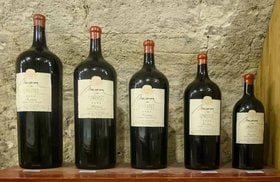
Wine comes in a wide range of bottle formats — from a quarter-bottle to the enormous Melchizedek. Here is the weight of each format when full:
| Format | Volume |
Equivalent (750ml bottles) |
Approx. Full Weight | Notes |
|---|---|---|---|---|
| Piccolo / Split | 187ml | 1/4 bottle | ~299g (0.66 lbs) | Single serve; common for Champagne and sparkling |
| Demi / Half bottle | 375ml | 1/2 bottle | ~599g (1.32 lbs) | Good for trying a wine before committing to a full bottle |
| Standard bottle | 750ml | 1 bottle | ~1.2–1.5kg (2.6–3.3 lbs) | Universal standard; most common format globally |
| Liter / Litre | 1,000ml | 1.33 bottles | ~1.6kg (3.5 lbs) | Common in Germany, Portugal, and some Italian regions |
| Magnum | 1,500ml | 2 bottles | ~2.1kg (4.6 lbs) | Preferred for aging; wine matures more slowly in larger format |
| Jeroboam (still wine) | 3,000ml | 4 bottles | ~4.8kg (10.6 lbs) | Champagne Jeroboam = 3L; Bordeaux Jeroboam = 4.5L |
| Rehoboam | 4,500ml | 6 bottles | ~7.26kg (16 lbs) | Used primarily for Champagne; impressive at events |
| Methuselah / Imperial | 6,000ml | 8 bottles | ~9.8kg (21.6 lbs) | Showpiece format for celebrations |
| Salmanazar | 9,000ml | 12 bottles / 1 case | ~14.5kg (32 lbs) | Equivalent to a full case; remarkable display piece |
| Balthazar / Balthasar | 12,000ml | 16 bottles | ~19.5kg (43 lbs) | Rare; mainly for large events |
| Nebuchadnezzar | 15,000ml | 20 bottles | ~24.4kg (54 lbs) | The largest commonly produced format |
| Melchior | 18,000ml | 24 bottles | ~29kg (64 lbs) | Very rare; requires two people to pour |
| Midas / Melchizedek | 30,000ml | 40 bottles | ~48kg (106 lbs) | Largest commercially available format; primarily Champagne |
Investment note on magnums: Magnum bottles (1.5L) are preferred by serious wine collectors because the larger format means slower, more gradual aging — the wine-to-glass ratio is lower, oxygen ingress is reduced, and the wine typically develops more complexity over time. Investment-grade Champagne, Bordeaux, and Burgundy often command a premium per bottle in magnum format.
How Much Does a Case of Wine Weigh?
A standard 12-bottle case of 750ml wine weighs approximately 13.6–18kg (30–40 lbs) including the cardboard box. The variance depends on bottle weight:
- A 12-bottle case of everyday thin-glass wine: approximately 13.6–15kg
- A 12-bottle case of premium wine: approximately 15–17kg
- A 12-bottle case of Champagne (heavy bottles): approximately 16–18kg
For investment-grade wine stored in original wooden cases (OWC), the case itself adds 2–4kg beyond the bottles. OWC cases are heavier but structurally superior and essential for preserving provenance value at auction.
| Case Format | Bottles |
Approximate Weight | Notes |
|---|---|---|---|
| Half case (6 bottles, standard) | 6 x 750ml | ~7–9kg | Common for fine wine purchase minimums |
| Standard case (12 bottles) | 12 x 750ml | ~13.6–18kg | Universal trade unit; OWC adds 2–4kg |
| Magnum case (6 magnums) | 6 x 1.5L | ~13–16kg | Same total volume as standard case; heavier bottles |
| Large case (24 bottles) | 24 x 750ml | ~27–36kg | Bulk purchase; requires pallet or multiple handlers |
How Much Does Boxed Wine Weigh?
Boxed wine (bag-in-box) is an eco-friendly and increasingly quality-conscious alternative to bottled wine. A standard 3-litre box contains the equivalent of 4 standard 750ml bottles:
- Approximately 3.2kg — meaningfully lighter than four standard bottles (which would weigh ~4.8–5.6kg combined)
- Approximately 5.3kg
The weight saving comes from the plastic bag-in-box design replacing four heavy glass bottles. Box wine is also more practical for shipping: the bag-in-box collapses as wine is poured, excluding oxygen and keeping wine fresher for longer after opening — often 4–6 weeks for an opened box versus 3–5 days for an opened bottle.
How Much Does a Wine Barrel Weigh?
A standard wine barrel (barrique) holds approximately 225 litres or 300 bottles of wine. The barrel itself weighs approximately 41–45kg when empty. Therefore:
- Full wine barrel: approximately 270–275kg (wine) + 43kg (barrel) = approximately 313–318kg
- A full wine barrel is roughly equivalent to the weight of an adult horse
Beyond the barrel, the next unit is a wine pallet — approximately 56 cases, equivalent to more than 2 wine barrels or approximately 672 standard 750ml bottles. A full wine pallet weighs approximately 750–1,000kg.
Wine Bottle Weight and Sustainability
Bottle weight has become an increasingly important environmental consideration. The wine industry estimates that approximately 40% of its total carbon footprint comes from glass bottle production and transport. Heavy bottles are more energy-intensive to produce and add significantly to shipping weight and therefore carbon emissions.
Many producers are now switching to lighter-weight bottles without compromising wine quality:
- 750ml bottles have dropped from an industry average of ~550g in 2000 to closer to ~420g in 2025 for everyday wines
- Some producers have adopted 300g lightweight bottles — a 40%+ reduction versus traditional premium glass
- The shift does not affect wine quality: glass composition matters more than weight for protection
For investment-grade wine, the transition to lighter bottles has been slower — heavy glass remains associated with premium positioning, and original wooden cases provide additional protection.
Practical Weight Guidance for Shipping Wine
If you are shipping wine — for a gift, for personal import, or as part of a collection — bottle weight directly affects shipping costs and packaging requirements:
- Declare approximately 1.5–2kg for shipping purposes, including packaging
- Plan for approximately 8–10kg with packaging
- Plan for approximately 16–20kg with packaging and box
- Add 20–30% to standard weight estimates due to heavier glass
For investment-grade wine collections, Vinovest handles all storage and logistics on behalf of clients — wine is stored in professional bonded warehouse facilities and fully insured at market value, removing the complexity of individual shipping and weight calculations.
Frequently Asked Questions
How much does a full bottle of wine weigh?
A standard full 750ml wine bottle weighs approximately 1.2–1.5kg (2.6–3.3 lbs). The wine itself is about 750g; the glass bottle adds 300–900g depending on thickness. Champagne and sparkling wine bottles are heaviest due to their thick glass.
How much does an empty wine bottle weigh?
An average empty wine bottle weighs approximately 500g (1.1 lbs), with a range of 300–900g depending on the bottle type. Sparkling wine and Champagne bottles are heaviest at 800–900g; lightweight everyday wine bottles can be as light as 300g.
How much does a case of wine weigh?
A standard 12-bottle case of 750ml wine weighs approximately 13.6–18kg (30–40 lbs) including the cardboard box. Cases of Champagne or premium wine with heavier glass bottles will be at the upper end of this range.
Does a heavier wine bottle mean better wine?
Not necessarily — though traditionally, premium wines have been packaged in heavier glass as a quality signal. A heavy bottle indicates higher production cost and provides better protection, but many excellent wines are now produced in lighter bottles for environmental reasons. The wine inside is the only reliable quality indicator.
How much does a magnum of wine weigh?
A full magnum (1.5L) wine bottle weighs approximately 2.1kg (4.6 lbs). The magnum format uses a larger, heavier glass bottle than a standard 750ml bottle. Magnums are popular for aging fine wine because the larger format slows the maturation process.
Last updated: June 2026 | Vinovest editorial team | Weight data sourced from Wine Folly, Eco-Spirits, and the original Vinovest wine bottle weight guide