Montepulciano d'Abruzzo wine: History, Prices & How to Buy It
Montepulciano d'Abruzzo is one of Italy's greatest wine secrets — a deeply colored, richly flavored red wine that delivers remarkable quality at prices that seem almost too good to be true. While collectors chase expensive Barolo and Brunello, savvy wine lovers know that Montepulciano d'Abruzzo offers genuine satisfaction at a fraction of the cost.
This comprehensive guide covers everything you need to know about Montepulciano d'Abruzzo: the grape, the region, top producers, food pairings, and why this wine deserves a permanent place in your rotation.
Further reading
- Read This Article if you’re keen to know how to cellar your Montepulciano in perfect conditions!
- Also, check out the famous Dom Perignon.
What Is Montepulciano d'Abruzzo?
Montepulciano d'Abruzzo is a red wine made from the Montepulciano grape in Italy's Abruzzo region, located along the Adriatic coast in central Italy. The wine takes its name from both the grape variety and the production zone.
Key Characteristics:
- Grape: 100% Montepulciano (or minimum 85% with other local varieties)
- Region: Abruzzo, central Italy
- Color: Deep ruby to purple, nearly opaque
- Body: Medium to full-bodied
- Tannins: Moderate, soft, approachable
- Alcohol: 12-14% ABV
- Flavors: Black cherry, plum, herbs, earth, pepper
- Price Range: $8-$40 (most under $20)
Important Distinction: Don't confuse Montepulciano d'Abruzzo with Vino Nobile di Montepulciano — they're completely different wines. Vino Nobile comes from Tuscany and is made from Sangiovese, while Montepulciano d'Abruzzo comes from Abruzzo and is made from the Montepulciano grape.
Why Montepulciano d'Abruzzo Is Special
Exceptional Value
Perhaps no Italian wine offers better quality-to-price ratio than Montepulciano d'Abruzzo. While comparable Tuscan wines command $30-$50+, excellent Montepulciano d'Abruzzo can be found for $10-$20.
Why It's So Affordable:
- High-yielding grape variety
- Less internationally famous than Sangiovese or Nebbiolo
- Large production region with competitive pricing
- Less marketing investment than "prestige" regions
Crowd-Pleasing Character
Montepulciano d'Abruzzo's soft tannins and generous fruit make it universally appealing:
- Not too tannic for beginners
- Enough structure for serious wine lovers
- Food-friendly without being demanding
- Enjoyable young (no cellaring required)
Versatility
Few wines pair with as wide a range of foods as Montepulciano d'Abruzzo. Its balanced acidity, moderate tannins, and herbal notes complement everything from pizza to grilled lamb.
The Region: Abruzzo
Abruzzo is often called "Italy's last unspoiled region" — a mountainous, rural area between the Apennines and the Adriatic Sea. The region's relatively undiscovered status keeps prices low while quality continues to improve.
Geographic Features:
- Mountains: Gran Sasso massif provides altitude variation
- Coast: Adriatic influence moderates temperatures
- Climate: Mediterranean with continental influences
- Soils: Varied — clay, limestone, sand
Wine Production:
- ~70% of Abruzzo's wine is Montepulciano d'Abruzzo
- Second most planted grape in Italy (after Sangiovese)
- DOC established 1968
- DOCG (Colline Teramane) established 2003
Taste Profile
Primary Flavors
Fruit: Black cherry, plum, blackberry, dark raspberry
Secondary Notes: Dried herbs, black pepper, tobacco, earth
Oak-Aged Versions: Vanilla, spice, chocolate, leather
Structure
Tannins: Moderate and soft — one of Montepulciano's most appealing qualities. The wine's tannins are ripe and approachable, never harsh or astringent.
Acidity: Medium — enough to pair with food but not aggressively sharp
Body: Medium to full — satisfying weight without heaviness
Finish: Medium-length with pleasant fruit and herb notes
Style Variations
Young/Unoaked: Bright fruit, minimal complexity, immediate pleasure
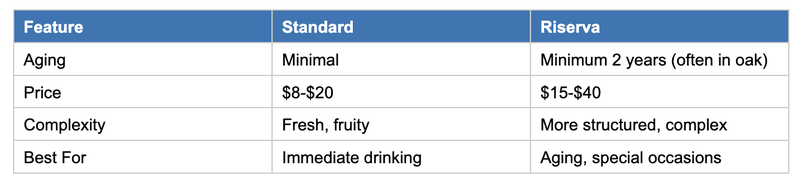
Riserva: Oak-aged minimum 2 years, more structure and complexity
Colline Teramane DOCG: Premium subzone, stricter regulations, higher quality
Best Montepulciano d'Abruzzo Producers (2026)
Top Quality Producers
Emidio Pepe
- The region's most prestigious producer
- Traditional methods, no added yeast
- Price: $40-$100+
- Age-worthy, complex, benchmark quality
Valentini
- Legendary estate with cult following
- Limited production, exceptional aging potential
- Price: $80-$200+
- Among Italy's greatest wines at any price
Masciarelli
- Modern quality pioneer
- Multiple tiers from everyday to premium
- Price: $12-$50
- Villa Gemma is flagship
Illuminati
- Family estate since 1890
- Excellent value across range
- Price: $10-$30
- Riparosso offers exceptional value
Cataldi Madonna
- Organic producer, gaining recognition
- Fresh, mineral-driven style
- Price: $15-$35
Best Value Producers
Fantini (Farnese)
- Large producer with consistent quality
- Widely distributed
- Price: $8-$15
- Great everyday option
Citra
- Cooperative with remarkable value
- Price: $8-$12
- Hard to beat at this price
Zaccagnini
- Known for twig-wrapped bottles
- Reliable quality
- Price: $10-$18
Valle Reale
- Organic, mountain-grown
- Fresh, vibrant style
- Price: $12-$20
Cantina Tollo
- Large cooperative, consistent
- Price: $8-$14
Montepulciano d'Abruzzo Price Guide (2026)
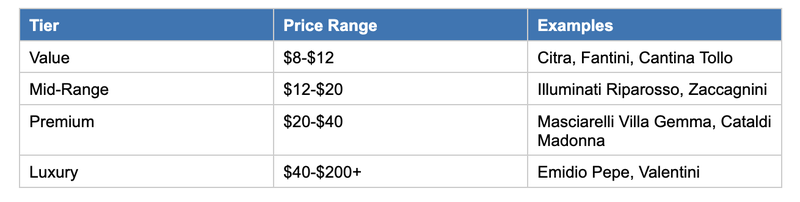
Best Value Pick: At $10-$15, wines from Illuminati, Fantini, and Valle Reale deliver quality that would cost twice as much from more famous regions.
Food Pairing Guide
Montepulciano d'Abruzzo is exceptionally food-friendly. Its moderate tannins and balanced acidity complement rather than compete with food.
Perfect Pairings
Italian Classics:
- Pizza (especially meat toppings)
- Pasta with red sauce
- Lasagna
- Spaghetti Bolognese
- Eggplant Parmesan
- Meatballs
Grilled Meats:
- Lamb chops
- Pork chops
- Italian sausages
- Grilled chicken (dark meat)
- Skirt steak
Cheese:
- Aged pecorino
- Parmigiano-Reggiano
- Provolone
- Fontina
- Asiago
Other Excellent Matches:
- Roasted vegetables (peppers, eggplant, zucchini)
- Mushroom risotto
- Bean dishes
- Hearty soups
- Charcuterie
Regional Pairing (Abruzzo Cuisine)
For authentic experience, pair with Abruzzese specialties:
- Arrosticini: Grilled lamb skewers (the classic pairing)
- Maccheroni alla chitarra: Square-cut pasta with meat sauce
- Pecorino: Local sheep's milk cheese
- Porchetta: Roasted pork
How to Serve Montepulciano d'Abruzzo
Temperature
Ideal serving temperature: 60-65°F (15-18°C)
Slightly below room temperature brings out fruit without alcohol heat. If stored at room temperature, 15-20 minutes in refrigerator helps.
Decanting
- Young/Value wines: No decanting needed
- Riserva: 30-60 minutes optional
- Aged wines (10+ years): Decant carefully for sediment
Glassware
Standard red wine glass works well. The wine doesn't require a specific shape — its approachable nature suits any occasion.
Aging Potential
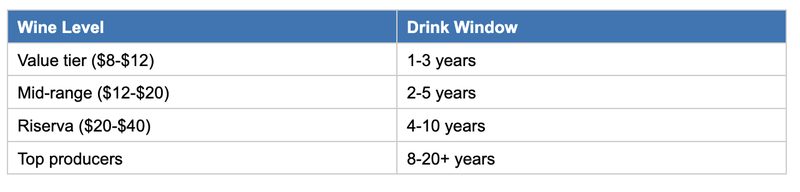
- Basic Montepulciano d'Abruzzo: Drink within 3-5 years
- Riserva: 5-10 years
- Top producers (Emidio Pepe, Valentini): 10-20+ years
Most Montepulciano d'Abruzzo is meant for early enjoyment — don't overthink it.
Montepulciano d'Abruzzo vs Similar Wines
vs. Chianti (Sangiovese)
- Montepulciano: Softer tannins, darker fruit
- Chianti: Higher acidity, brighter cherry fruit
- Price: Montepulciano typically 30-50% less
vs. Primitivo/Zinfandel
- Montepulciano: More herbal, less jammy
- Primitivo: Riper, higher alcohol, more fruit-forward
- Both: Great value, food-friendly
vs. Malbec
- Montepulciano: More restrained, herbal notes
- Malbec: Bolder, more concentrated
- Both: Soft tannins, approachable
vs. Nero d'Avola
- Montepulciano: Lighter body, more herbal
- Nero d'Avola: Fuller, more intense
- Both: Italian value champions
The Bottom Line
Montepulciano d'Abruzzo is the thinking person's everyday red wine. It delivers genuine quality, food-friendly character, and authentic Italian tradition at prices that invite exploration rather than hesitation.
For $10-$15, you can enjoy wines that hold their own against bottles costing twice as much from more famous regions. For $20-$40, you enter territory that rivals Italy's finest. And at the top tier, producers like Emidio Pepe and Valentini prove that Montepulciano d'Abruzzo can achieve true greatness.
Whether you're grilling on a Tuesday night or hosting a dinner party, Montepulciano d'Abruzzo belongs in your rotation. It's Italy's best-kept wine secret — and at these prices, it should be everyone's everyday red.
Vintage Guide: Best Years
Outstanding Recent Vintages
2019 ★★★★★
- Exceptional balance and depth
- Rich fruit with firm structure
- Excellent aging potential
- Status: Buy and cellar or drink now
2017 ★★★★☆
- Warm vintage, ripe generous fruit
- Approachable and delicious
- Drinking beautifully now
- Status: Ready to enjoy
2016 ★★★★★
- Classic vintage with excellent structure
- Long-term aging potential
- Complex and layered
- Status: Starting to open
2015 ★★★★☆
- Rich and concentrated
- Forward and generous style
- Medium-term cellaring
- Status: Drinking well
Aging Recommendations
Health and Nutrition
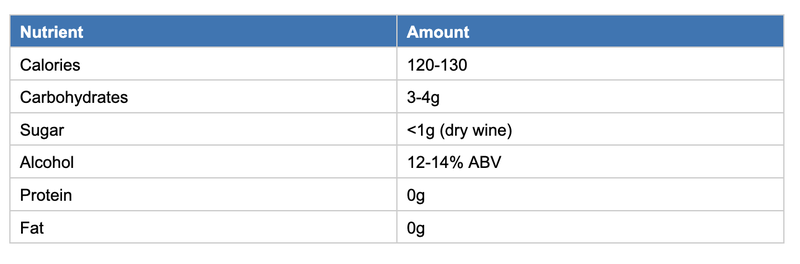
Per 5 oz (150ml) Serving
Antioxidant Benefits
Montepulciano d'Abruzzo contains notable levels of:
- Resveratrol: Found in grape skins
- Anthocyanins: Color pigments with antioxidant properties (high levels due to thick skins)
- Polyphenols: Various beneficial compounds
Moderate Consumption
When enjoyed in moderation (1-2 glasses daily), red wine may offer:
- Cardiovascular benefits
- Antioxidant consumption
- Social and relaxation benefits
Note: Benefits apply only to moderate consumption. Excessive alcohol carries health risks.
Frequently Asked Questions
How do you pronounce Montepulciano d'Abruzzo?
"Mon-teh-pull-CHAH-no dah-BROOD-zo" — five syllables for Montepulciano, three for d'Abruzzo.
Is Montepulciano d'Abruzzo the same as Vino Nobile di Montepulciano?
No! This is a common confusion:

Vino Nobile is named after the town of Montepulciano in Tuscany. Montepulciano d'Abruzzo is named after the grape variety.
Is Montepulciano d'Abruzzo sweet or dry?
Montepulciano d'Abruzzo is a dry red wine with less than 1 gram of residual sugar per glass. The ripe fruit flavors may create a perception of sweetness, but it's technically dry.
What does Montepulciano d'Abruzzo taste like?
Expect flavors of:
- Black cherry and plum (dominant)
- Blackberry and dark raspberry
- Dried herbs and black pepper
- Earth and tobacco (aged versions)
- Vanilla and spice (oak-aged versions)
The texture is smooth with soft, approachable tannins.
Is Montepulciano d'Abruzzo good for beginners?
Excellent for beginners. Its soft tannins, generous fruit, and approachable style make it one of the most beginner-friendly red wines. It's also affordable, encouraging exploration.
How long does Montepulciano d'Abruzzo last after opening?
- With cork/stopper: 3-5 days refrigerated
- Without seal: 1-2 days
- Tip: Use vacuum pump to extend life
What food pairs best with Montepulciano d'Abruzzo?
Best pairings:
- Pizza with meat toppings
- Pasta with red sauce
- Grilled lamb
- Italian sausages
- Aged cheeses
Why it works: The wine's moderate tannins and balanced acidity complement rather than overpower food.
Should Montepulciano d'Abruzzo be chilled?
Serve slightly below room temperature (60-65°F / 15-18°C). If stored at room temp, 15-20 minutes in the refrigerator helps. Don't serve it ice cold — you'll mute the flavors.
What's the difference between Montepulciano d'Abruzzo and Montepulciano d'Abruzzo Riserva?
Why is Montepulciano d'Abruzzo so affordable?
Several factors:
- High-yielding grape variety
- Less international fame than Sangiovese or Nebbiolo
- Large production region with competition
- Lower land and labor costs than Tuscany
- Less marketing investment
What's Colline Teramane?
Colline Teramane is a DOCG subzone within Montepulciano d'Abruzzo, representing the highest quality tier:
- Stricter production rules
- Lower yields
- Longer aging requirements
- Higher prices ($20-$50)
- Located in Teramo province
Can you cook with Montepulciano d'Abruzzo?
Absolutely. It's excellent for:
- Braising meats
- Red wine reductions
- Tomato-based sauces
- Risotto
- Beef stew
Its moderate tannins and fruit-forward character work well in cooking.
Is Montepulciano d'Abruzzo vegan?
Most are vegan-friendly, though some producers use animal-based fining agents. Check labels or contact producers if this is important to you.
What glass should I use?
Standard red wine glass works perfectly. Montepulciano d'Abruzzo doesn't require specialized stemware — its approachable nature suits any occasion.
Why does Zaccagnini have a twig on the bottle?
The twig (called "tralcetto") is a trademark of the Zaccagnini winery, symbolizing the rustic, artisanal character of their wines. It's become an iconic identifier for the brand.
Most Montepulciano d’Abruzzo is priced and produced for everyday drinking, not long term appreciation. If you want wine exposure with stronger resale demand and proven track records, invest in blue chip regions and producers through Vinovest. We source, authenticate, store, and insure your wine, and manage it like an asset.