Romanée-Conti (DRC): The Complete Guide to Prices, Wines, and Investment (2026)
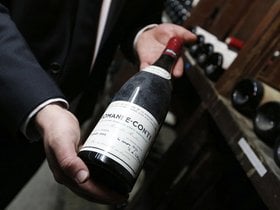
Domaine de la Romanée-Conti, universally known as DRC, represents the absolute pinnacle of Burgundy winemaking and arguably the most prestigious wine producer on Earth. When a single bottle of 1945 Romanée-Conti sold for $558,000 at Sotheby's New York in October 2018, it confirmed what collectors already knew: DRC produces some of the most valuable wines ever made.
But DRC isn't merely expensive — it's exceptional. The combination of irreplaceable terroir, meticulous biodynamic viticulture, tiny production volumes, and centuries of winemaking tradition creates wines of transcendent quality that justify their astronomical prices. For serious collectors and investors, understanding DRC is essential to navigating the fine wine market.
This guide covers everything you need to know about DRC wines in 2026: the complete portfolio with current pricing, investment performance data, buying strategies, authentication concerns, best vintages, and why these bottles command stratospheric valuations.
Further reading
- Want to discover more about the world of wine investment? Check our Ultimate Guide on Investing in Wine.
- Explore other highly-coveted wines from the Bordeaux wine region or discover the Iconic Domaine Leflaive from Cote de Beaune.
Understanding Domaine de la Romanée-Conti
History and Heritage
DRC is not merely a winery — it's a 400-year legacy of Burgundian excellence built on the belief that specific pieces of land produce irreplaceable wines.
The name "Romanée-Conti" combines two historical threads. "Romanée" dates to the vineyard's early reputation (possibly referencing Roman origins or a medieval road), while "Conti" honors Louis François, Prince de Conti, who purchased the vineyard in 1760 for the extraordinary sum of 8,000 livres — nearly ten times what had been paid for the prestigious Clos de Bèze a decade earlier.
Legend holds that the Prince outbid Madame de Pompadour, mistress to King Louis XV, in a legendary rivalry. Though historians have debunked this romantic tale, the Prince's acquisition established the terroir's exceptional status. He reportedly kept all the vineyard's wines for personal consumption, refusing to share even with his dearest friends at his lavish Parisian parties.
Following the French Revolution, the estate changed hands several times before Jacques-Marie Duvault-Blochet purchased it in 1869. His descendants, the de Villaine and Leroy/Roch families, co-own the domaine today. Aubert de Villaine served as co-director for 48 years before stepping back in recent years, with his nephew Bertrand de Villaine now overseeing the estate.
Why DRC Commands Extraordinary Prices
Structural Scarcity: DRC produces approximately 80,000 bottles annually across all wines from just 28 hectares (69 acres). Compare this to Bordeaux First Growths like Château Lafite Rothschild, which produce 180,000-300,000 bottles annually from larger estates. The flagship Romanée-Conti itself yields just 5,000-6,000 bottles per year — approximately 450 cases.
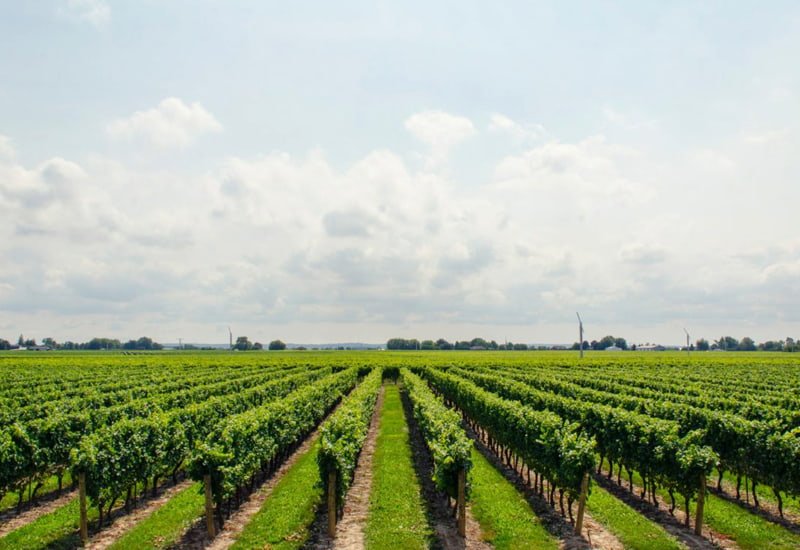
Irreplaceable Terroir: The Romanée-Conti vineyard occupies just 1.81 hectares (4.5 acres) of specific Vosne-Romanée soil. This terroir — the unique combination of iron-rich limestone, eastern exposure, precise elevation (240 meters), and microclimate — cannot be duplicated anywhere on Earth. You cannot create more Romanée-Conti; you can only buy what exists.
Meticulous Viticulture: The domaine practices organic and biodynamic farming, with horses reintroduced to avoid soil compaction. Average vine age exceeds 44 years. Yields are kept extraordinarily low at approximately 25 hl/ha — meaning three vines produce just one bottle of wine. Severe pruning, green harvesting, and rigorous sorting ensure only the finest grapes reach fermentation.
Winemaking Philosophy: DRC uses whole-cluster fermentation (including stems), extended maceration, and new oak aging with minimal intervention. The goal is expressing terroir, not making "wine" in a conventional sense.
Track Record: DRC has produced exceptional wine consistently for over 50 years under modern ownership, building collector confidence that every bottle will deliver.
The Complete DRC Wine Portfolio
DRC produces seven Grand Cru red wines from Pinot Noir and two Grand Cru white wines from Chardonnay. Each wine has distinct characteristics, production levels, and price profiles.
Romanée-Conti Grand Cru (The Flagship)
A 1.81-hectare monopole (sole ownership) vineyard producing just 5,000-6,000 bottles annually — approximately 450 cases. Romanée-Conti is the densest, most aristocratic expression of Pinot Noir imaginable.
Wine critic Clive Coates described it as "the purest, most aristocratic and most intense example of Pinot Noir you could possibly imagine. Not only nectar: a yardstick with which to judge all other Burgundies."
Roald Dahl wrote: "To drink Romanée-Conti is equivalent to experiencing an orgasm at once in the mouth and in the nose."
The wine is impossibly long-lived, with great vintages evolving for 50-100 years. In youth, expect rose petal, red cherry, and exotic spice; with age, truffle, earth, and ethereal complexity emerge.
2026 Price Range: $24,000-$35,000 per bottle (varies significantly by vintage)
Historic Vintages: 1945 ($558,000 auction record), 2005 ($40,000+), 1990 ($15,000+)
La Tâche Grand Cru Monopole
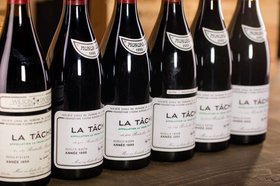
DRC's largest holding at 6.06 hectares, also a monopole, producing approximately 20,000 bottles (1,600 cases) annually. La Tâche is more immediately expressive than Romanée-Conti in youth, displaying intoxicating violets, exotic spice, dark fruit, and a distinctive liquorice-tinged structure.
Aubert de Villaine describes La Tâche as "very vertical and sharp, but surrounded by a lot of lace and velvet." Where Romanée-Conti whispers, La Tâche sings.
At July 2024 Sotheby's auction, a magnum of 2005 La Tâche set a world record at €35,000, while a three-bottle lot of 2014 La Tâche exceeded €9,100 per bottle.
2026 Price Range: $5,500-$8,600 per bottle
Wine-Searcher Average: $6,926 (all vintages)
Richebourg Grand Cru
At 3.51 hectares, DRC is the largest owner of this Grand Cru, producing about 12,000 bottles (1,000 cases) annually. Richebourg is the most powerful, structured DRC wine — bold, muscular, requiring at least a decade of cellaring.
De Villaine calls Richebourg "the musketeer, the bodyguard of Romanée-Conti, and a wine that wants to laugh." Dark fruit, earth, and formidable tannins define young Richebourg; with age, it develops remarkable complexity while maintaining power.
2026 Price Range: $2,200-$5,700 per bottle
Investment Performance: Strong demand from Asian collectors has driven 40%+ appreciation for top vintages
Romanée-Saint-Vivant Grand Cru
DRC acquired 5.29 hectares in 1966 (leased, then purchased in 1988), producing roughly 18,000 bottles annually. This wine has two faces: "one face is very elegant and fine, close to Romanée-Conti in finesse; the other side is more abrupt, monastic even," according to de Villaine.
Often considered the most "feminine" DRC red after Romanée-Conti itself, RSV offers exceptional value relative to quality within the portfolio.
2026 Price Range: $1,800-$4,800 per bottle
Value Proposition: Frequently the most accessible entry to DRC's Vosne-Romanée character
Grands Échézeaux Grand Cru
DRC holds 3.53 hectares of this relatively flat vineyard southwest of Clos Vougeot, producing about 14,000 bottles annually. The wines are broader, richer, and earthier than Échézeaux, with darker fruit, more structure, and excellent aging potential.
At July 2024 Sotheby's auction, a three-bottle lot of 2005 Échézeaux set a world record at €10,000 per bottle.
2026 Price Range: $1,500-$4,600 per bottle
Échézeaux Grand Cru
DRC's 4.67 hectares in the "Les Poulaillères" section yield approximately 16,000 bottles annually. Generally lighter-bodied than Grands Échézeaux but displaying similar gamey, bramble-fruit character with violet aromatics.
Often considered the "entry point" to DRC reds, though at $1,200+ per bottle, "entry" is relative.
2026 Price Range: $1,200-$3,900 per bottle
Investment Note: Historically undervalued; recent auction results suggest appreciation accelerating
Corton Grand Cru
The newest red addition to DRC, from 2.27 hectares leased in 2008 with first vintage released in 2012. Located on the hill of Corton in the Côte de Beaune (rather than Côte de Nuits like other DRC reds), this wine is still establishing its identity in the marketplace.
Production is minuscule — rumored to be only slightly more than the ~475 cases of Romanée-Conti itself.
2026 Price Range: $800-$1,500 per bottle
Investment Potential: As the newest DRC wine, Corton represents a speculative opportunity — prices may rise significantly as the wine gains recognition
Montrachet Grand Cru (White)
DRC's legendary white wine, produced from Chardonnay on just 0.67 hectares in the world's greatest white wine vineyard. With production around 2,500-3,000 bottles annually, this is the most expensive dry white wine in the world.
Production is so limited that DRC didn't release Montrachet in 1992 or 2016 due to insufficient yields.
At July 2024 Sotheby's auction, a three-bottle lot of 2007 Montrachet set a world record at €15,800 per bottle.
2026 Price Range: $7,700-$12,200 per bottle (recent vintages)
2015 Vintage: $35,257 (Wine-Searcher)
Corton-Charlemagne Grand Cru (White)
The newest white addition, first vintage 2019. Extremely limited quantities from this prestigious white Burgundy vineyard make this a sought-after rarity for completists.
2026 Price Range: Market still establishing; expect $2,000-$4,000
DRC Investment Performance
Historical Returns
DRC wines have delivered exceptional investment returns, consistently outperforming broader fine wine indices across all time horizons:
Portfolio Performance (Lay & Wheeler Trading data):
- 1-Year Return: 31.33% average across DRC portfolio
- 5-Year Return: 122.07%
- 10-Year Return: 261.55%
Benchmark Comparison:
- Liv-Ex Burgundy 150: +2.44% (1yr), +126.86% (5yr), +227.35% (10yr)
- Liv-Ex 100 (broader market): +17.86% (1yr), +33.91% (5yr), +55.11% (10yr)
- S&P 500 (equity comparison): Lower than DRC over 10-year period
DRC has significantly outperformed both the broader fine wine market and traditional equity indices, with lower volatility than stocks during market corrections.
Recent Auction Performance (2024-2025)
The secondary market for DRC remains extraordinarily strong despite broader economic uncertainty:
Sotheby's Beaune Auction (July 2024) — Four new world records from Pierre Chen cellar:
- 2007 Montrachet (3-bottle lot): €15,800 per bottle (record)
- 2005 La Tâche magnum: €35,000 (record)
- 2014 La Tâche (3-bottle lot): €9,100+ per bottle (record)
- 2005 Échézeaux (3-bottle lot): €10,000 per bottle (record)
iDealwine Auctions (January 2025):
- Consistent strong results across DRC portfolio
- Buyers from Europe, Asia, and worldwide demonstrating global demand
- Premium vintages (2005, 2009, 2015) commanding highest premiums
Historic Records:
- 1945 Romanée-Conti: $558,000 (Sotheby's New York, October 2018) — highest price ever for a single bottle of Burgundy
- 1929 Les Gaudichots (pre-DRC bottling): $88,125 per case
Why DRC Appreciates
- Absolute Scarcity That Increases Over Time
DRC produces approximately 80,000 bottles annually — a number that cannot meaningfully increase. The domaine's vineyard holdings are fixed, and their commitment to low yields prevents production expansion. Meanwhile, every bottle consumed permanently reduces global supply. This creates a one-way ratchet effect on scarcity.
- Expanding Global Collector Base
Wealthy collectors in Asia — particularly China, Hong Kong, Taiwan, and Singapore — have dramatically expanded DRC demand over the past 15 years. This is not a temporary trend; as Asian wealth creation continues, the buyer pool for DRC will continue growing while supply remains static.
- Allocation System Creates Immediate Premiums
DRC wines are virtually impossible to obtain at release without longstanding relationships with the domaine or its exclusive importers. Secondary market premiums begin immediately upon release, as most bottles trade above release price from day one.
- Quality Consistency Across Vintages
Unlike many Burgundy producers, DRC delivers excellence even in challenging vintages. While 2003 or 2004 may be "lesser" years by DRC standards, they still dramatically outperform most Burgundy. This consistency builds collector confidence and reduces vintage risk.
- Universal Brand Recognition
"DRC" is universally recognized among wine collectors worldwide. This recognition provides liquidity that smaller Burgundy producers cannot match. A bottle of DRC can be sold in New York, London, Hong Kong, or Tokyo with equal ease.
- Dual Value Proposition
DRC offers both financial appreciation and the potential for a transcendent drinking experience. Unlike purely financial assets, wine can ultimately be consumed and enjoyed. This "consumption option" provides downside protection — even if prices fell, you'd still own some of the greatest wines ever made.
Investment Risk Factors
Liquidity Constraints: While DRC is more liquid than most Burgundy, selling still requires auction consignment or finding private buyers. This is not a daily-traded asset.
Authentication Challenges: Counterfeiting is a significant concern. The "Dr. Conti" scandal revealed the scale of DRC forgery. Proper authentication is essential.
Concentration Risk: DRC represents a single domaine in a single region. Diversification across producers and regions is prudent.
Storage Requirements: Improper storage destroys value. Professional storage costs must be factored into return calculations.
Market Sentiment: Fine wine prices can decline during severe economic downturns, though DRC has historically been more resilient than most.
Best Vintages for Investment
Legendary Vintages (Trophy Status)
2005: Considered one of the greatest Burgundy vintages of the 21st century. Exceptional structure, concentration, and aging potential. La Tâche 2005 commands €35,000+ at auction.
2009: Ripe, generous vintage with immediate appeal but serious structure beneath. Romanée-Conti 2009 regularly exceeds $30,000.
2010: Structured, classical vintage requiring patience. Excellent long-term investment given aging potential. Often considered the best value among recent legendary years.
2015: Outstanding vintage with both concentration and elegance. Romanée-Conti 2015 currently $35,257 (Wine-Searcher).
2019: Most recent "great" vintage with critical acclaim and strong initial demand.
Strong Investment Vintages
2012: Excellent quality despite challenging conditions. Slightly lower prices than surrounding vintages create value opportunity.
2016: Classical, elegant vintage. 2016 La Tâche listed at €5,454 ex-cellar.
2017: Underrated vintage showing remarkable quality despite frost-reduced yields.
Value Vintages (Quality Relative to Price)
2014: Excellent wines often overlooked between the celebrated 2015 and 2012. 2014 La Tâche: €9,100+ (July 2024 auction).
2011: Good quality, attractive pricing relative to neighbors. Mature and approaching optimal drinking windows.
Vintages Requiring Caution
2004: Uneven vintage with variable results
2003: Hot year produced atypical wines that divided critics
2007: Irregular quality
How to Buy DRC
The Allocation System
DRC sells through a strict allocation system that makes obtaining bottles extremely difficult. Understanding this system is essential for anyone hoping to acquire DRC:
The Distribution Chain:
Domaine → Négociants/Importers: DRC allocates to established partners in each market
Importers → Retailers/Restaurants: Further allocation to key accounts
Retailers → Customers: Final allocation to privileged clients
Each step involves significant markup, and allocations decrease at each level.
Getting on Allocation Lists requires:
- Established purchasing history with a retailer (often 5-10+ years)
- Willingness to purchase other wines to maintain standing (some retailers require "assortment" purchases)
- Financial capacity to buy when offered (allocations are use-it-or-lose-it)
- Patience and relationship-building with sommeliers and wine directors
- Living in a market with DRC access (not all regions have importers)
The Reality: Most collectors will never obtain DRC at release prices. The allocation system is designed to reward long-term relationships, not accommodate new buyers. Secondary market purchase — through auction or specialist retailers — is the practical path for most.
Release Prices vs. Market Prices: Even when allocations are available, release prices are significantly below market prices. A bottle of Romanée-Conti might be released at $5,000-$8,000 but trade immediately at $25,000+ on the secondary market. This premium reflects both scarcity and the difficulty of obtaining allocation.
Auction Houses
For those without allocation access, auctions provide the primary secondary market:
Major Auction Houses with Burgundy Expertise:
- Sotheby's: Global network with specialized Burgundy sales in New York, Hong Kong, London, and Beaune
- Christie's: Strong presence in major markets
- Acker Merrall & Condit: Named DRC "most important wine producer in the world" in 2012; specialist in fine Burgundy
- Hart Davis Hart: Chicago-based with excellent Burgundy catalog
- Zachys: New York-based with regular Burgundy offerings
- Bonhams: Growing presence in fine wine
Auction Considerations:
- Buyer's premiums: 20-25% (factor this into total cost)
- Provenance documentation: Essential for DRC; request full chain of custody
- Condition reports: Review carefully; request additional photos if needed
- Estimate prices: For DRC, hammer prices frequently exceed estimates significantly
- Competition: Major lots attract global bidding; be prepared to exceed estimates
- Timing: Major sales occur in spring and fall; Beaune auction in July has become significant
Auction Strategy:
- Set maximum bids in advance and stick to them
- Factor in buyer's premium, shipping, and insurance
- Research recent comparable sales
- Consider "off-peak" sales where competition may be less intense
- Build relationships with auction specialists who can provide guidance
Specialist Retailers
Some retailers specialize in Burgundy and maintain DRC inventory:
UK-Based:
- Lay & Wheeler (trading arm handles secondary market)
- Berry Bros. & Rudd (historic merchant with occasional DRC)
- Corney & Barrow (UK importer, allocation access)
- Farr Vintners (secondary market specialist)
- Fine + Rare (inventory-based)
US-Based:
- Chambers Street Wines (New York; Burgundy specialist)
- Rosenthal Wine Merchant (importer)
- Kermit Lynch (importer)
- K&L Wine Merchants (California; occasional inventory)
Hong Kong/Asia:
- Grand Cru Liquid Assets
- Berry Bros. Hong Kong
- Various auction houses with retail operations
Wine Investment Platforms
Platforms like Vinovest provide an alternative approach:
- Professional authentication: Critical for DRC
- Climate-controlled bonded storage: Optimal conditions guaranteed
- Insurance coverage: Protection against loss or damage
- Liquidity assistance: Help with sales when ready
- Portfolio diversification: Guidance on balancing DRC with other wines
- Expertise: Navigation of authentication and provenance issues
- Tax efficiency: Potential advantages of bonded storage
For collectors without deep wine expertise or storage infrastructure, platforms offer access to DRC with professional management.
Authentication Concerns
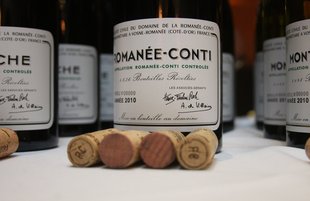
Given DRC's extraordinary values, counterfeit bottles are a serious concern. The "Dr. Conti" scandal (Rudy Kurniawan, now serving a 10-year prison sentence) revealed the scale of DRC counterfeiting.
Protecting Yourself
Buy from reputable sources: Established auction houses or retailers with provenance verification systems
Examine documentation: Original purchase records, storage history, chain of custody
Inspect bottles carefully:
- Labels: Printing quality, font consistency, vintage-specific details
- Capsules: Correct materials, proper application, no signs of tampering
- Fill levels: Appropriate for age (some evaporation expected in old bottles)
- Cork condition: Consistent with stated age
- Glass: Correct bottle shape and color for vintage
Consider professional authentication: For high-value purchases ($5,000+), authentication services are worthwhile
If the price seems too good: It probably is. Deep discounts on DRC should trigger extreme skepticism.
Red Flags
- Sellers unwilling to provide detailed provenance
- Bottles from unknown or recently emerged collections
- Labels showing inconsistencies with reference examples
- Cork or capsule irregularities
- Fill levels inconsistent with age
- Prices significantly below market
Storage Requirements
DRC wines require impeccable storage:
- Temperature: 55°F (13°C), rock-stable with no fluctuation
- Humidity: 65-75%
- Darkness: Essential; UV damages wine
- Position: Horizontal to keep cork moist
- Vibration: Minimal
- Isolation: Away from strong odors
Professional Storage: For bottles worth $1,000+, bonded warehouse storage provides:
- Optimal conditions
- Insurance coverage
- Provenance documentation
- Security
- Potential tax advantages (duty deferral)
The DRC Experience
Beyond investment returns, DRC wines offer transcendent drinking experiences that justify their prices for those fortunate enough to open a bottle.
Wine critic Robert Parker wrote of the 2019 Romanée-Conti: "This is a wine that brought tears to my eyes."
Allen Meadows (Burghound) described it simply: "Burgundy doesn't get any better than this."
Clive Coates, MW, called Romanée-Conti "the purest, most aristocratic and most intense example of Pinot Noir you could possibly imagine. Not only nectar: a yardstick with which to judge all other Burgundies."
For collectors who eventually open their investment bottles, this is the ultimate reward — wines that justify their prices with every sip, creating memories that last a lifetime.
Tasting Notes: What to Expect
Romanée-Conti: In youth, expect rose petal, red cherry, exotic spice, and ethereal perfume. With age (15-30+ years), truffle, earth, dried flowers, and ineffable complexity emerge. The texture is impossibly silky, the finish seemingly endless.
La Tâche: More immediately expressive than RC. Intoxicating violets, dark berries, exotic spice, and a distinctive liquorice note. Powerful yet elegant, with remarkable structure for long aging.
Richebourg: The most muscular DRC wine. Dark fruit, earth, formidable tannins in youth. Requires patience — 15+ years minimum for great vintages. Rewards patience with extraordinary complexity.
Romanée-Saint-Vivant: Two faces — one elegant and fine (approaching RC in finesse), another more structured and "monastic." Often the best value in the portfolio relative to quality.
When to Drink DRC
Wine | Minimum Age | Optimal Window | Maximum
Romanée-Conti | 15 years | 20-50 years | 100+ years
La Tâche | 12 years | 15-40 years | 75+ years
Richebourg | 15 years | 20-45 years | 60+ years
Romanée-Saint-Vivant | 10 years | 15-35 years | 50+ years
Grands Échézeaux | 10 years | 12-30 years | 45+ years
Échézeaux | 8 years | 10-25 years | 40+ years
Corton | 8 years | 10-25 years | 35+ years
Montrachet | 10 years | 15-35 years | 50+ years
These are guidelines for exceptional vintages properly stored. Lesser vintages and imperfect storage reduce potential.
Building a DRC Portfolio
Entry Strategy ($10,000-$25,000)
For investors beginning their DRC journey:
- Start with 2-3 bottles of Échézeaux or Corton (most accessible entry points)
- Focus on strong vintages (2015, 2019) with appreciation potential
- Store professionally from day one
- Plan for 10+ year holding period
Growth Strategy ($50,000-$100,000)
For serious collectors building positions:
- Diversify across multiple wines (La Tâche, Richebourg, RSV, Échézeaux)
- Include 1-2 legendary vintages (2005, 2009, 2010) for trophy holdings
- Consider Montrachet for white wine diversification
- Build vertical collections (same wine, multiple vintages) for premium potential
Collector Strategy ($250,000+)
For major collectors seeking comprehensive exposure:
- Target Romanée-Conti in select vintages
- Build complete assortments (all wines from single vintage)
- Include older vintages (1990s, 1980s) for immediate drinking potential
- Consider large formats (magnums) for scarcity premium
The Bottom Line
DRC represents the pinnacle of wine investment. The combination of micro-production, irreplaceable terroir, impeccable winemaking, and insatiable global collector demand creates a fundamentally sound investment thesis. Historical returns (31% one-year, 122% five-year, 262% ten-year) speak for themselves.
The primary challenges are access and capital requirements. Even "entry-level" DRC wines (Échézeaux, Corton) cost $1,000-$1,500 per bottle. Allocations are virtually impossible to obtain. Auction competition is fierce. Authentication requires expertise.
For investors who can navigate these challenges, DRC offers:
- Proven appreciation track record
- Global liquidity (buyers in every major market)
- Structural scarcity that only increases with time
- The possibility of eventually experiencing some of the greatest wines ever made
That dual return — financial appreciation and potential for transcendent drinking experience — is rare in any investment category.
Build a Burgundy strategy with Vinovest. Get help sourcing hard-to-find bottles, keep them stored and insured in professional facilities, and track your portfolio in one dashboard as it matures.