Vinovest Quarterly Report Q1 2026
The first quarter of 2026 has been a period of divergent momentum across the alternative spirits and fine wine landscape. While the fine wine market reached a point of "cautious stability," the rare whiskey market experienced a landmark surge in auction desirability. The late-February escalation of the Iran War introduced a new layer of macro-volatility, pressuring global equities and Gulf luxury hubs. However, the fine wine and rare spirits sectors have demonstrated a notable "decoupling" from traditional equities, with buyer intent at a two-year high – bolstered by the imminent "unlocked" demand from the newly signed EU–India Trade Deal.
Further reading
Catch up on last quarter's report here.
By The Numbers
- +0.6%: YTD performance of the Liv-ex Fine Wine 50
- 97%: Wealth managers and advisors who expect fine wine demand to rise in 2026, per the WineCap Wealth Report 2026 – the highest reading in the study’s four-year history.
- ~25%: Peak-to-trough decline of the Liv-ex Fine Wine Investables Index from its 2022 high of 415 to approximately 313 – the baseline from which the current recovery is building.
- 31.3%: The monthly price rise of Chateau La Fleur-Petrus 2022 in February, showcasing the potential for double-digit gains in high-conviction assets.
$2.5 Million: Total value achieved at the landmark Sotheby's American Whiskey auction in January
Wine: Stability Meets Geopolitical Headwinds
The fine wine market’s narrative in Q1 has been one of consolidation. After showing sustained growth through late 2025 and early 2026, major indices saw a marginal correction in March as global caution increased.
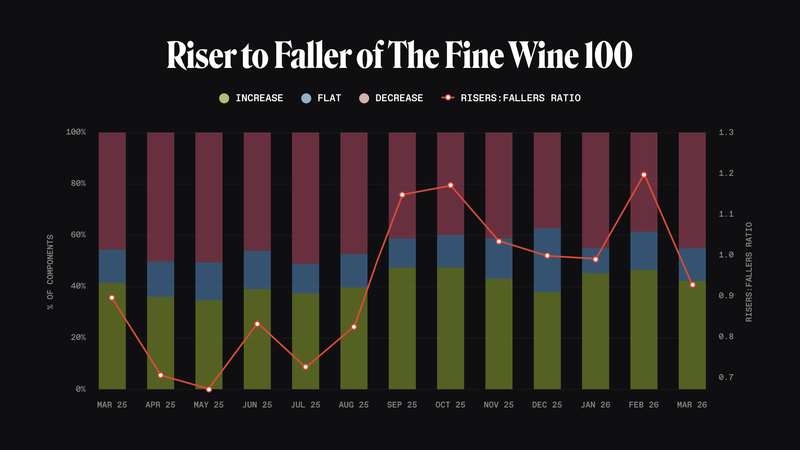
- The March Pivot: After five months of rising values, the Liv-ex 100 and Fine Wine 50 posted their first modest declines since August 2025, dipping -0.3% and -0.1% respectively. Despite this, the year-to-date (YTD) trajectory remains positive, with the Fine Wine 50 still up 0.6% for the quarter.
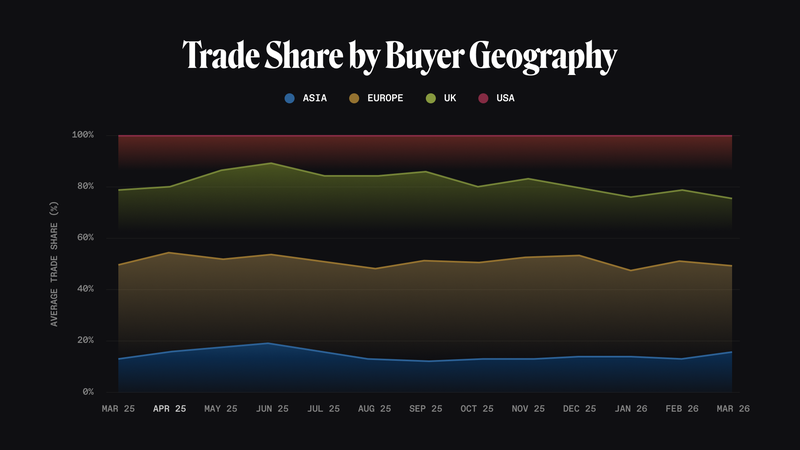
- The US Resurgence: A standout trend in Q1 has been the continued rise of US buying activity. Despite the broader market’s "wait-and-see" approach to the Iran War, American collectors have aggressively deployed capital, helping trade value and volume remain above the 2025 quarterly average.
- Supply-Side Friction: A growing point of tension is emerging as we head into the spring. While importers are calling for "no-brainer" release pricing for the 2025 Bordeaux vintage to sustain the recovery, some producers are considering price increases – a move that could risk the market’s newfound stability.
- The Institutional Pivot: The WineCap Wealth Report 2026 found that over a third of committed HNW investors now allocate 21–30% of their total wealth to fine wine – a sharp jump from just 2% in the 2025 report. WineCap CEO Alexander Westgarth frames this as fine wine moving from "the periphery of the balance sheet to a core defensive pillar," with 50% of U.S. and 35% of UK respondents specifically citing global conflict as a tailwind for the asset class.
- The Measured View: Not all commentary is bullish. Liv-ex itself expects the market to "bump along the bottom throughout 2026," and Bordeaux Index’s Geraint Carter has noted he doesn’t expect prices to fall but also struggles to see them rising meaningfully. Liv-ex analyst Sophia Gilmour advises buyers to focus on where sellers have capitulated and which wines offer the highest nominal gains – this remains a stock-picker’s market, not a tide-rises-all-boats environment.
Whiskey: The Auction Powerhouse
If wine was the picture of stability, whiskey was the engine of record-breaking growth. Q1 2026 has solidified the "institutionalization" of American Bourbon on the global stage.
- The Sotheby’s Landmark: January saw the historic "Great American Whiskey Collection" auction, which doubled its pre-sale estimates to reach a total of $2.5 million. This event marked the sale of the most valuable American whiskey bottle in history: the 1982 Old Rip Van Winkle 20-Year-Old "Sam’s", which hammered at $162,500.
- The Demographic Tilt: The collector profile is undergoing a rapid evolution. Over 50% of the successful bidders in recent high-value spirits auctions were aged 40 or younger, and 96% of the volume was driven by North American collectors.
- Cask Momentum: Beyond bottles, whiskey casks continue to deliver annual returns between 12–15%, bolstered by new WOWGR regulations implemented in 2025 that have streamlined warehouse ownership for private investors.
Looking Ahead: Q2 & H2 Outlook
The remainder of 2026 will be defined by two critical catalysts: the Bordeaux 2025 En Primeur campaign and the evolving EU–India trade deal.
The Bordeaux Litmus Test
The upcoming Bordeaux releases are the "must-watch" event of the spring. For the recovery to accelerate, producers must offer the 2025s at prices that are undeniably competitive against back-vintages already in the market. Any attempt to raise prices in the current climate could stifle the liquidity seen in Q1.
Global Trade Realignment
Speculative Outlook: If the Iran conflict remains localized and shipping lanes stabilize by early summer, fine wine and rare spirits are poised to act as a premier "inflation hedge" in the second half of the year. Investors should focus on older, prestige Bordeaux First Growths (which have reached their highest demand levels since 2022) and ultra-aged American Bourbon, both of which are showing price consolidation patterns indicative of a new growth cycle.
We also anticipate a significant volume surge in the second half of the year as the EU–India free trade agreement (signed in January 2026) takes full effect. The deal reduces Indian tariffs on premium EU wines from 150% to 20% (and 30% for mid-range wines), phased in over the coming years, opening a billion-person consumer market that has been effectively closed to investment-grade wine. The UK is pursuing a separate trade track, which could extend these dynamics to Scotch and English sparkling wine if concluded. India has already reclaimed its position as the largest importer of Scotch by volume, and the removal of trade barriers is expected to drive massive demand for premium aged expressions.
A caveat worth keeping in mind: as Liv-ex founder James Miles has noted, fine wine has no income stream like property and a fundamentally different liquidity profile, and WineFi’s post-2011 data shows fine wine prices now track liquidity, credit, and currency movements more than collector demand. Vinovest investors should continue to think in 3–5 year horizons, not quarters. Within that frame, the current "horizontal" movement in wine prices combined with the vertical records in spirits creates a balanced environment for the disciplined investor. We recommend a diversified approach: accumulating stable Bordeaux and Burgundy assets while selectively targeting ultra-aged American Bourbon and rare single-malt casks that benefit from tightening global supply.